---
title: How to create shifts in your venue (10 mins)
description: Learn how to create and manage venue shifts in Eat App, including availability types, booking rules, pacing settings, and common shift setup examples.
---
[Skip to content](https://restaurant.eatapp.co/knowledge/creating-your-restaurants-shift#main-content)
English
Show submenu for translations
[Can't find what you're looking for?](https://restaurant.eatapp.co/knowledge/kb-tickets/new)
![Eat App Logo - Small.png\]](https://restaurant.eatapp.co/hs-fs/hubfs/Eat%20App%20Logo%20-%20Small.png?height=40&name=Eat%20App%20Logo%20-%20Small.png)
- [Our About Page](https://restaurant.eatapp.co/about)
- [Contact Us](https://restaurant.eatapp.co/contact-us)
- [View Our Blogs](https://restaurant.eatapp.co/blog)
Open main navigation
Close main navigation
- [Our About Page](https://restaurant.eatapp.co/about)
- [Contact Us](https://restaurant.eatapp.co/contact-us)
- [View Our Blogs](https://restaurant.eatapp.co/blog)
- English
Show submenu for translations
- [Can't find what you're looking for?](https://restaurant.eatapp.co/knowledge/kb-tickets/new)
- restaurant.eatapp.co
restaurant.eatapp.co
Eat App Knowledgebase
- There are no suggestions because the search field is empty.
1. [Help Center](https://restaurant.eatapp.co/knowledge)
2. [Getting Started](https://restaurant.eatapp.co/knowledge/getting-started)
3. [Get set up with the most useful things on EAT App in less than 30 minutes](https://restaurant.eatapp.co/knowledge/getting-started#get-set-up-with-the-most-useful-things-on-eat-app-in-less-than-30-minutes)
# How to create shifts in your venue (10 mins)
## Learn how to create and manage venue shifts in Eat App, including availability types, booking rules, pacing settings, and common shift setup examples.
***In this article:***
- [**Creating your Venue's shift**](https://restaurant.eatapp.co/knowledge/creating-your-restaurants-shift#Creating-your-Venues-shift)
- [**Availability Type**](https://restaurant.eatapp.co/knowledge/creating-your-restaurants-shift#Availability-Type)
- [**Availability Sync Information**](https://restaurant.eatapp.co/knowledge/creating-your-restaurants-shift#availability-sync-information)
- [**Common Shift Setups**](https://restaurant.eatapp.co/knowledge/creating-your-restaurants-shift#Common-Shift-Setups)
### Creating your Venue's shift
To activate your online bookings, you would need to create a shift from the [Table Manager.](https://app.eatapp.co/) This Shift is where the system would base what timeframes are available for your guests to choose from.
Your Venue's shifts can be edited from the [Table Manager](https://app.eatapp.co/).
To start, go to the **Availability** section and click **Shifts.**
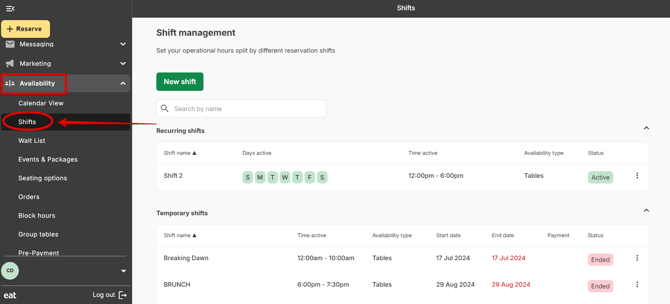
To add a new shift, click the **New shift** button. A pop-up window will appear, guiding you through each step of creating your shift.
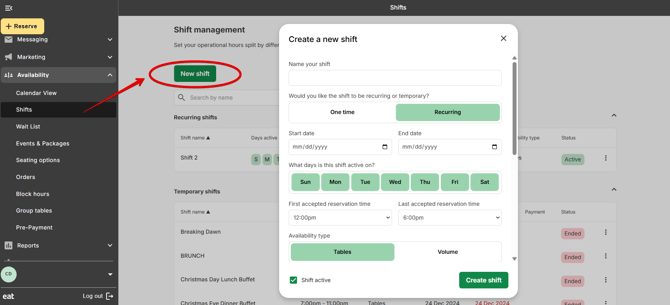
1\. Give the **shift** a **name**
2\. Choose a **shift type**. Decide whether the shift will be **recurring** (repeats on selected days of the week) or a **one-time shift** (temporary)**.**
- Temporary shifts can overlap with recurring shifts.
- Two recurring shifts, however, cannot overlap.
3\. Set the **date range.**
- For **recurring shifts**, this step is optional — the shift will run indefinitely until you set it to inactive.
- For **temporary** or **one-time shifts**, a date range is mandatory. One-time shift will run every day between the start and end dates.
4\. Select the **time** for the **first** and **last accepted reservation**. This does not indicate when the restaurant shift starts and ends, but rather the range where customers can either [make reservations](https://restaurant.eatapp.co/knowledge/creating-reservations-1) or walk in.
5\. Choose the **Availability Type**
A. **Tables**:
- This will auto-assign bookings to tables based on your availability.
- The maximum number of bookings you can accommodate depends on your Venue's floor layout.
B. **Volume**:
- This will allow you to choose the total number of customers you want to seat during this shift.
- This will not have automatic table assignments; you will need to manually assign a table for each reservation, or create a [preference](https://restaurant.eatapp.co/knowledge/using-payments-by-preference) with table assignments.
- The system will keep accepting bookings until it reaches the **Total online covers** you have set.
6\. Set the **minimum** and the **maximum** number of **covers** (guests)for each booking.
7\. Set the **time slot.** This controls the spacing or interval between available reservation times.
- Example: If you set **15 minutes**, customers will see booking options every 15 minutes (1:00 pm, 1:15 pm, 1:30 pm, and so on).
8\. Assign a **notice period**. This will determine the minimum time in advance that customers need to reserve before the shift begins or their preferred time slot.
- Example: If you set **2 hours**, the earliest time slot a guest can book at 11:00 am is 1:00 pm time slot.
9\. **Customize reservation durations**: If toggled ON, reservation duration or booking length will be adjusted based on the number of covers (party size). You can leave it OFF to apply one default duration for all reservations in this shift.
10\. **Pacing**: This allows you to control how many guests your venue can accommodate during a shift. It includes two settings:
- **Limit Arrival of guests** - You can control the number of covers you can accommodate in **every time slot,** either by having the same pacing applied to all slots or by having custom pacing for every slot.
- **Set a maximum venue capacity** - You can set the total number of covers allowed for the entire shift. This cap applies across the **whole shift**, not per time slot, and if set too low or incorrectly selected, may cause the shift to appear fully booked even when tables are still available.
11\. **Attach a payment to this shift**: If your plan includes the **prepayment feature**, you can link a payment rule to this shift. This requires guests to make a payment at the time of booking. Click here to [create payment](https://restaurant.eatapp.co/knowledge/using-payments-by-preference).
12\. Assign a **color** to the shift. Adding a color makes it easier to visually identify bookings that belong to this shift in the [Table Manager](https://app.eatapp.co/).
13\. Click "**Create shift**"
A progress status bar appears after you create or update your availability. These changes are reflected almost instantly on the Eat App widget. However, if [**Google Reserve integration**](https://restaurant.eatapp.co/knowledge/activating-google-reservation) is active:
- **Newly created shifts** may take up to **48 hours** to show
- Changes to **existing shifts** may take **8–24 hours** to appear
### Common Shift Setups
#### Scenario #1: Lunch Shift
> I want to set up a lunch shift that takes place everyday of the week except Friday. I want customers to only be able to make bookings for tables that are empty. The shift starts at noon and will run until 4pm, but I don't want new guests showing up past 3pm so we can close at 4pm on the dot to prepare for dinner. My team needs to know 15 minutes in advance that a customer is coming and I don't want customers staying more than 1 hour as this shift is usually very busy. This shift will run indefinitely for now.
#### Scenario #2: Valentine's Day Dinner
> Valentine's Day is coming up and I want to make sure I can receive bookings in advance for this specific night. I want customers to only be able to make bookings on February 14th for tables of two (since our venue will be entirely catered towards couples on this night) and only on tables that are available. Our Valentine's Dinner shift will run from 6pm to 12am but we want the last customers to arrive at 11pm. Our team needs to know at least 48 hours in advance for bookings on Valentine's Day since this is a particularly busy night for us.
#### Scenario #3: Wine Tasting Night
> I want to set up a wine tasting event for my venue that takes place next Tuesday night from 6pm to 9pm. Regardless of the amount of tables we have available, we only want 50 guests per shift as our staff cannot handle more than that. Guests need to book at least 24 hours in advance to this event and should not be able to book more than parties of 10.
#### Scenario #4: Friday Brunch
> Our venue is launching a Friday brunch next week that will last for an entire year. I need to set up a shift that runs every Friday from 12pm to 3pm with the last guests arriving at 2 pm. Regardless of the amount of tables we have available, we only want 300 guests to show up for the brunch. Bookings need to be placed at least 24 hours in advance and we have no restriction on party size.
Head to the [payments help page](https://restaurant.eatapp.co/knowledge/managing-payments) to learn about creating payment rules which can be auto-assigned to shifts for automatic payments.
### Using Shifts to Manage Venue Capacity
- [Eat App Overview](https://restaurant.eatapp.co/knowledge/eat-app-overview)
- [Getting Started](https://restaurant.eatapp.co/knowledge/getting-started#main-content)
- [Get set up with the most useful things on EAT App in less than 30 minutes](https://restaurant.eatapp.co/knowledge/getting-started#get-set-up-with-the-most-useful-things-on-eat-app-in-less-than-30-minutes)
- [Layout](https://restaurant.eatapp.co/knowledge/getting-started#layout)
- [Permissions and Preferences](https://restaurant.eatapp.co/knowledge/getting-started#permissions-and-preferences)
- [Feature Guides](https://restaurant.eatapp.co/knowledge/feature-guides#main-content)
- [Views Management](https://restaurant.eatapp.co/knowledge/feature-guides#views-management)
- [Multi-Restaurant Support](https://restaurant.eatapp.co/knowledge/feature-guides#multi-restaurant-support)
- [Managing reservations](https://restaurant.eatapp.co/knowledge/feature-guides#managing-reservations)
- [Waitlist](https://restaurant.eatapp.co/knowledge/feature-guides#waitlist)
- [Widget](https://restaurant.eatapp.co/knowledge/feature-guides#widget)
- [Guest Messaging](https://restaurant.eatapp.co/knowledge/feature-guides#guest-messaging)
- [Restaurant Tags](https://restaurant.eatapp.co/knowledge/feature-guides#restaurant-tags)
- [Users](https://restaurant.eatapp.co/knowledge/feature-guides#users)
- [Server/Waiter Management](https://restaurant.eatapp.co/knowledge/feature-guides#server-waiter-management)
- [Guest Database](https://restaurant.eatapp.co/knowledge/feature-guides#guest-database)
- [Payments](https://restaurant.eatapp.co/knowledge/feature-guides#payments)
- [Restaurant Reports](https://restaurant.eatapp.co/knowledge/feature-guides#restaurant-reports)
- [Guest Reviews](https://restaurant.eatapp.co/knowledge/feature-guides#guest-reviews)
- [Restaurant Automation](https://restaurant.eatapp.co/knowledge/feature-guides#restaurant-automation)
- [Offers/Discounts](https://restaurant.eatapp.co/knowledge/feature-guides#offers-discounts)
- [Layout](https://restaurant.eatapp.co/knowledge/feature-guides#layout)
- [Restaurant Billing](https://restaurant.eatapp.co/knowledge/feature-guides#restaurant-billing)
- [Printing](https://restaurant.eatapp.co/knowledge/feature-guides#printing)
- [Customer Support](https://restaurant.eatapp.co/knowledge/feature-guides#customer-support)
- [WhatsApp Messaging](https://restaurant.eatapp.co/knowledge/feature-guides#whatsapp-messaging)
- [Integrations](https://restaurant.eatapp.co/knowledge/integrations#main-content)
- [Wix Integration](https://restaurant.eatapp.co/knowledge/integrations#wix-integration)
- [Payment Integration](https://restaurant.eatapp.co/knowledge/integrations#payment-integration)
- [MCP Servers](https://restaurant.eatapp.co/knowledge/integrations#mcp-servers)
- [FAQs](https://restaurant.eatapp.co/knowledge/faqs)
- [Troubleshooting](https://restaurant.eatapp.co/knowledge/troubleshooting)
- [Release Notes](https://restaurant.eatapp.co/knowledge/release-notes)
- [Partnerships](https://restaurant.eatapp.co/knowledge/partnerships)
- [Documentation](https://restaurant.eatapp.co/knowledge/documentation#main-content)
- [Widget setup](https://restaurant.eatapp.co/knowledge/documentation#widget-setup)
- [Navi](https://restaurant.eatapp.co/knowledge/navi)
[](https://restaurant.eatapp.co)
Help Center
Copyright © 2026, Grow
```json
{
"@context" : "https://schema.org",
"@type" : "VideoObject",
"contentUrl" : "https://3390327.fs1.hubspotusercontent-na1.net/hubfs/3390327/Lunch%20Shift.mp4",
"dateModified" : "2024-07-02T03:37:59.110Z",
"duration" : "PT26S",
"height" : 732,
"name" : "Lunch Shift",
"thumbnailUrl" : "https://3390327.fs1.hubspotusercontent-na1.net/hubfs/3390327/Lunch%20Shift.mp4/medium.jpg",
"uploadDate" : "2024-07-02T03:37:59.105Z",
"width" : 1182
}
```
```json
{
"@context" : "https://schema.org",
"@type" : "VideoObject",
"contentUrl" : "https://3390327.fs1.hubspotusercontent-na1.net/hubfs/3390327/Valentines%20Shift.mp4",
"dateModified" : "2024-07-02T03:45:22.694Z",
"duration" : "PT26.322S",
"height" : 732,
"name" : "Valentines Shift",
"thumbnailUrl" : "https://3390327.fs1.hubspotusercontent-na1.net/hubfs/3390327/Valentines%20Shift.mp4/medium.jpg",
"uploadDate" : "2024-07-02T03:45:22.689Z",
"width" : 1182
}
```
```json
{
"@context" : "https://schema.org",
"@type" : "VideoObject",
"contentUrl" : "https://3390327.fs1.hubspotusercontent-na1.net/hubfs/3390327/Wine%20Tasting.mp4",
"dateModified" : "2024-07-02T03:57:49.051Z",
"duration" : "PT15S",
"height" : 732,
"name" : "Wine Tasting",
"thumbnailUrl" : "https://3390327.fs1.hubspotusercontent-na1.net/hubfs/3390327/Wine%20Tasting.mp4/medium.jpg",
"uploadDate" : "2024-07-02T03:57:49.045Z",
"width" : 1182
}
```
```json
{
"@context" : "https://schema.org",
"@type" : "VideoObject",
"contentUrl" : "https://3390327.fs1.hubspotusercontent-na1.net/hubfs/3390327/Friday%20Brunch.mp4",
"dateModified" : "2024-07-02T05:27:28.050Z",
"duration" : "PT18S",
"height" : 732,
"name" : "Friday Brunch",
"thumbnailUrl" : "https://3390327.fs1.hubspotusercontent-na1.net/hubfs/3390327/Friday%20Brunch.mp4/medium.jpg",
"uploadDate" : "2024-07-02T05:27:28.045Z",
"width" : 1182
}
```