



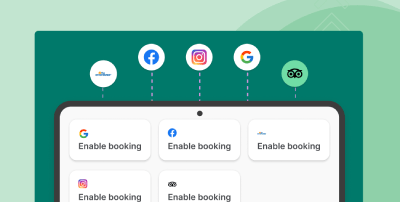


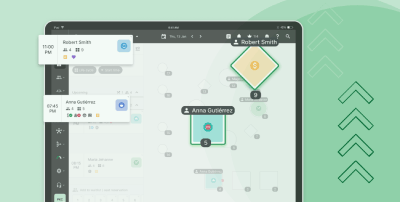
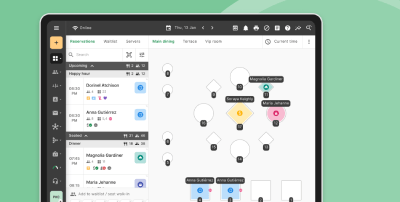





























The best restaurant reservation system depends on how you get your diners. Eat App is the best overall pick for most independent restaurants and groups: it has a real free plan, flat monthly pricing on direct bookings, and a full guest CRM. OpenTable has the largest diner network, but charges per seated network cover. Resy (which now includes Tock) suits upscale venues that want marketplace reach on a flat fee. SevenRooms suits hotel and enterprise groups that want deep CRM. Toast Tables makes sense only if you already run Toast POS.
We compared 14 systems on real cost per cover, guest data ownership, features, and support.
Disclosure: Eat App is our product. We hold it to the same template and list its limitations.
Quick picks by situation
|
Situation |
Our pick |
Why |
|---|---|---|
|
Best overall |
Free plan, flat monthly price on direct bookings, full CRM and WhatsApp messaging |
|
|
Best free |
Free plan up to 100 covers a month with table management. resOS is free up to 25 bookings |
|
|
Best for small restaurants |
Free up to 100 covers a month; every paid plan, from Lite at $99, has no cover cap |
|
|
Best for fine dining |
Flat fee, Amex cardholder demand, ticketed and prepaid experiences from Tock |
|
|
Best for groups and hotels |
Deep CRM, group reporting and 100+ integrations, quoted by sales |
|
|
Best for discovery |
Largest diner network, paid per seated network cover |
|
|
Best if you are on Toast |
Syncs table status with Toast POS in real time |
Jump to a review: Eat App · OpenTable · Resy · Tock · SevenRooms · Yelp Guest Manager · Toast Tables · ResDiary · Hostme · TheFork · Servme · Tablein · resOS · Table Agent
Comparison table: 14 reservation systems at a glance
Prices are in the vendor's own currency, excluding tax. "Monthly" means billed month to month; "annual" means the monthly rate when you pay for a year.
|
System |
Best for |
Starting paid price (monthly / annual) |
Free plan |
Per-cover fees |
Guest data ownership |
POS integration |
Prices verified |
|---|---|---|---|---|---|---|---|
|
Eat App |
Most independents and groups |
$99 / $69 (Lite) |
Yes, 100 covers/mo |
None; bookings are commission-free |
Restaurant |
+$39/mo on Lite and Core; included on Pro |
19 Oct 2026 |
|
OpenTable |
Discovery volume |
$149 (Basic, US only); annual not public |
No (Basic free for 30 days) |
$1.50 (Basic) or $1.00 (Core, Pro) per network cover; Basic also $0.25 per website cover or $49/mo flat |
Mixed: network diners are OpenTable's |
Core and Pro |
19 Oct 2026 |
|
Resy |
Upscale and fine dining |
$289 / no annual rate published |
No |
None |
Restaurant on direct bookings; Resy keeps its marketplace users |
Platform tier up |
19 Oct 2026 |
|
Tock (now part of Resy) |
Prepaid and ticketed dining |
$289 (Essential) / no annual rate |
No |
None; 3% (Essential) or 2% (Premium) on prepayments |
Restaurant on direct bookings; Resy keeps its marketplace users |
Premium tier |
19 Oct 2026 |
|
SevenRooms |
Hotel and enterprise groups |
Not public, quoted by sales |
No |
None |
Restaurant on direct bookings; DoorDash keeps its marketplace guests |
Yes, 100+ integrations |
19 Oct 2026 |
|
Yelp Guest Manager |
Yelp-driven US discovery |
$159 / $129 (Basic) |
No |
None |
Mixed: Yelp marketplace |
Plus tier up |
22 Oct 2026 |
|
Toast Tables |
Toast POS users |
Not public; two tiers sold as Toast POS add-ons |
No |
None |
Restaurant (in Toast) |
Toast POS only |
19 Oct 2026 |
|
ResDiary |
UK and APAC venues wanting white-label |
£109 / £109 (Evo Connect, UK) + VAT |
No |
None |
Restaurant |
£10/mo add-on |
19 Oct 2026 |
|
Hostme |
US independents wanting all-in-one |
$109 / $98 (Mezzo) |
No (14-day trial) |
None on direct bookings; $2.50 per cover on Tripadvisor and Michelin Guide bookings |
Restaurant |
Grande tier |
19 Oct 2026 |
|
TheFork |
Restaurants relying on TheFork in Europe |
Not public, quoted by sales; varies by country |
No |
Commission per cover on TheFork and partner bookings |
Mixed: TheFork marketplace |
Varies by market |
19 Oct 2026 (no public price) |
|
Servme |
MENA restaurants and hotels |
$129 per venue, billed annually (Starter); monthly not published |
No |
None; 1% on deposits and pre-authorizations |
Restaurant |
Advanced tier |
19 Oct 2026 |
|
Tablein |
Small European restaurants |
€67 / $79 (Starter, 50 bookings); annual only on Success |
No (14-day trial) |
€0.67 (Starter) or €0.37 (Growth) per booking over the limit |
Restaurant |
No |
19 Oct 2026 |
|
resOS |
Very small venues |
$47 / $37 (Basic) |
Yes, 25 bookings/mo |
None |
Restaurant |
Limited |
19 Oct 2026 |
|
Table Agent |
Basic booking on zero budget |
$0; payments or SMS $29/mo |
Yes |
None |
Mixed: listed on Table Agent unless you pay $30/mo |
No |
19 Oct 2026 |
No-show protection compared
Price tells you what a system costs. No-show tools decide how many covers you lose. We checked what each system offers to prevent no-shows, using the vendor's own pages. "Not stated" means we could not confirm the feature on the vendor's public pages. It does not mean the feature is missing. Checked 26 Oct 2026.
|
System |
Automated reminders |
Guest can confirm or cancel |
Deposits and card holds |
No-show fee to card |
Waitlist |
Offers freed slots automatically |
What it costs |
|---|---|---|---|---|---|---|---|
|
Eat App |
SMS, email, WhatsApp |
Yes |
Deposits, prepayments, card holds |
Yes |
Walk-in and online |
Partly: table-ready alerts |
SMS: contact us; WhatsApp allowances on paid plans |
|
OpenTable |
SMS, email |
Yes, with Premium SMS |
Deposits, prepayments, card holds |
Yes |
Walk-in and online |
Partly: Notify Me alerts diners, who rebook themselves |
Premium SMS $24/mo on Core, included on Pro; 2% on prepaid experiences |
|
Resy |
SMS |
Not stated |
Deposits, prepayments, card holds |
Yes |
Walk-in, online and Notify |
Yes (Notify) |
Standard payment processing fees |
|
Tock |
SMS, email |
Yes, two-way text |
Deposits, prepayments, card holds |
Yes |
Walk-in, online and Notify |
Yes (Notify) |
3% (Essential) or 2% (Premium) on prepayments |
|
SevenRooms |
SMS, email |
Yes, two-way SMS |
Deposits, prepayments, card holds |
Yes |
Walk-in and online |
Yes (Priority Alerts) |
Quoted by sales |
|
Yelp Guest Manager |
Automated alerts; channel not stated |
Two-way texting |
Card holds only |
Yes, charged by staff |
Walk-in and online |
Yes (Notify Me) |
Card holds need Plus: $349/mo or $279/mo annual |
|
Toast Tables |
SMS |
Yes, by text reply |
Deposits, prepayments, card holds |
Yes, charged by staff (US) |
Walk-in and online |
Not stated |
Not public; card processing fees apply |
|
ResDiary |
Email; SMS with add-on |
Yes, by email link |
Deposits, prepayments, stored cards |
Yes, charged by staff |
Walk-in, same day |
Not stated |
SMS add-on plus per-message fees; 1% on deposits and payments |
|
Hostme |
SMS, email, WhatsApp |
Yes |
Deposits, card holds |
Cancellation fees; no-show charge not stated |
Walk-in and online |
Not stated |
Unlimited SMS and WhatsApp in the US and Canada |
|
TheFork |
Email, push; SMS on Performance |
Reconfirmation requests |
Card guarantee, prepayments |
Not stated |
Online, when full |
Not stated |
Quoted by sales; commission on marketplace bookings |
|
Servme |
SMS, WhatsApp (add-ons) |
Not stated |
Deposits, prepayments, card holds |
Yes |
Walk-in and online |
Partly: table-ready alerts |
1% on payments (Starter); SMS and WhatsApp are paid add-ons |
|
Tablein |
Email, SMS |
Yes, by email link |
Deposits, prepayments, card on file |
Yes, charged by staff |
Phone and online |
No; staff contact the guest |
SMS billed by usage |
|
resOS |
Email, SMS (add-ons) |
Yes |
Deposits, prepayments, card holds |
Yes, automatic |
Online (paid add-on) |
No |
Payments, SMS and waitlist are paid add-ons; not on Free |
|
Table Agent |
SMS (add-on) |
Not stated |
Deposits, prepayments |
Not stated |
Walk-in |
Not stated |
SMS from $29/mo; payments $29/mo, no transaction fee |
What stands out: almost every system now takes deposits or card holds. The real difference is what happens after a cancellation. Resy, Tock, SevenRooms and Yelp Guest Manager alert waitlisted guests automatically when a slot opens. Most others rely on staff to fill the gap. Check the cost column too: SMS and payments are often paid add-ons, so your real price can be higher than the plan price.
How we evaluated these reservation systems
We scored each platform on six criteria, weighted by how much they matter to an operator choosing a system:
|
Criterion |
Weight |
What we checked |
|---|---|---|
|
Pricing and value |
25% |
Monthly and annual price, per-cover fees, caps, add-ons and setup fees |
|
Core features |
25% |
Reservations, table management, waitlist, deposits and no-show protection |
|
CRM and guest data |
20% |
Guest profiles, who owns the data, marketing and loyalty tools |
|
Ease of use |
10% |
Setup time, interface, mobile apps |
|
Integrations |
10% |
POS, Reserve with Google, social channels, PMS, payments |
|
Customer support |
10% |
Hours, channels and onboarding model |
How we checked prices. Every price comes from the vendor's own pricing page, checked in October 2026. We do not use prices from G2, Capterra, or GetApp. Where a vendor does not publish a price, we write "Not public, quoted by sales" and do not estimate. Each price states its billing period.
How we tested. We used each product's public booking widget or demo account and captured dated screenshots during this review.
We read verified reviews on G2 and Capterra and spoke to restaurant operators who use Eat App in 90+ countries.
Our bias. Eat App is our product. To limit that bias, every tool gets the same review template, including a cons list for Eat App. Competitor claims are factual and dated.
Real cost at 500, 1,500, and 3,000 covers a month
At 1,500 covers a month, OpenTable Core costs $8,988 a year, Resy $3,468, and Eat App Lite $1,188. The plan price matters less than how each system charges as you grow.
Assumptions. One location. 30% of covers come from the tool's own marketplace network; the rest book direct (website, phone, social). We use the cheapest plan that includes table management and handles the volume, billed monthly. For tools priced per booking, we assume 2.5 covers per booking. Servme publishes only annual-billing prices, so we use those. Tax, extra messaging, payment processing, and optional add-ons are excluded.
|
System |
Plan used |
500 covers/mo |
1,500 covers/mo |
3,000 covers/mo |
Pricing model |
|---|---|---|---|---|---|
|
Table Agent |
Free |
$0 |
$0 |
$0 |
Free core; paid add-ons |
|
resOS |
Basic $47 / Plus $98 / Unlimited $149 |
$564 |
$1,176 |
$1,788 |
Flat, tiered by bookings |
|
Eat App |
Lite $99 |
$1,188 |
$1,188 |
$1,188 |
Flat, commission-free, no cover cap |
|
Hostme |
Mezzo $109 |
$1,308 |
$1,308 |
$1,308 |
Flat on direct bookings |
|
Servme |
Starter $129 (billed annually) |
$1,548 |
$1,548 |
$1,548 |
Flat |
|
Yelp Guest Manager |
Basic $159; Plus $349 above 500 covers |
$1,908 |
$4,188 |
$4,188 |
Flat, tiered by covers |
|
Resy / Tock |
Platform or Essential $289 |
$3,468 |
$3,468 |
$3,468 |
Flat |
|
OpenTable |
Core $299 + $1 per network cover |
$5,388 |
$8,988 |
$14,388 |
Plan + per-cover on network bookings |
Not in the table: SevenRooms, Toast Tables and TheFork do not publish prices. ResDiary prices in pounds by bookings: £1,740, £2,460 and £3,540 a year plus VAT and a £99 setup fee. Tablein prices by bookings with overage fees in euros.
What the numbers show:
- OpenTable's network fees overtake the Core subscription at about 300 network covers a month. At 3,000 covers, cover fees are 75% of the bill.
- Flat plans cost the same at 500 or 3,000 covers once you pass the tier caps. Yelp Basic stops at 500 covers, and resOS, Tablein and ResDiary tier by bookings. Eat App's paid plans have no cover cap.
- Per-cover fees grow with your success. Use marketplaces to find new guests, and move regulars to direct booking.
Formula. Annual cost = 12 × (monthly plan price + network share × monthly covers × fee per network cover). Example for OpenTable Core at 1,500 covers: 12 × ($299 + 0.30 × 1,500 × $1.00) = $8,988.
Marketplace vs direct booking: who owns the guest data
When a guest books on a marketplace, the marketplace keeps the relationship. When a guest books on your own website, Google profile or Instagram, you do.
Marketplaces such as OpenTable, Resy, TheFork, Yelp and DoorDash Reservations (powered by SevenRooms) bring you diners who did not know you. In return, they hold the diner's account, send their own emails and can show the same diner other restaurants. Some charge you for every seated network cover, even when the diner is a regular who simply used the app.
Direct booking works the other way. The guest profile, visit history and marketing consent sit in your own system. You can thank the guest, invite them back and run a loyalty program without paying per visit.
Most restaurants need both. A sensible split:
- Use a marketplace to fill quiet shifts and reach new diners.
- Send every guest a reason to book direct next time.
- Check the contract for who may email the guest, and whether you can export guest data if you leave.
In this guide, "Restaurant" in the data column means the restaurant controls profiles from direct bookings. "Mixed" means the platform keeps marketplace guests as its own customers.
The 14 best restaurant reservation systems, reviewed
Every review uses the same template. Prices are list prices from the vendor's pricing page, excluding tax.
1. Eat App
Best for: Independent restaurants and groups that want flat pricing and their own guest data.
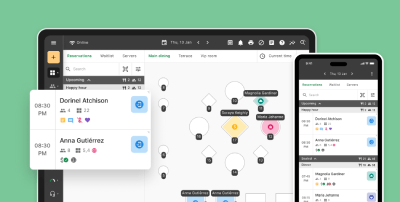
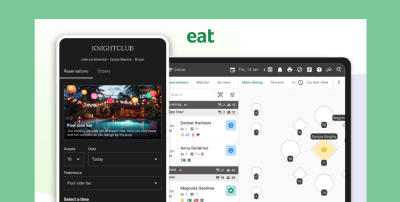
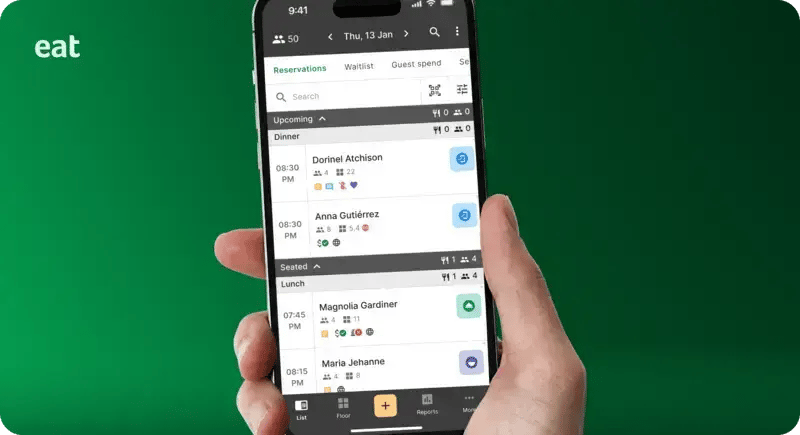
Overview: Eat App is a cloud reservation, table management and guest CRM system. It runs on iPad, web, iOS and Android. Guests book from your website, Google, Instagram, Facebook and the Eat App partner network, and you message them on WhatsApp and SMS from the reservation book.
Pros
- Free plan up to 100 covers a month; every paid plan has unlimited covers.
- Commission-free bookings: no per-cover or per-booking fees on any plan.
- Messaging included: 500 SMS on Lite, 2,000 on Core and unlimited on Pro, plus 100, 250 or 500 WhatsApp messages a month of each type (utility and marketing).
- AI tools included on Core and Pro, and AI phone answering through the Millie AI and MyAutobot integrations.
Cons
- Smaller diner network than OpenTable or Resy, so it brings fewer new diners on its own.
- POS and payment integrations cost $39 a month each on Lite and Core.
- Lite covers only the basics: the marketing suite and white-labeling need Core. The Free plan has no SMS, and some AI features carry a usage-based fee.
Pricing
|
Plan |
Monthly |
Annual (per month) |
Includes |
|---|---|---|---|
|
Free |
$0 |
$0 |
100 covers/mo, reservations and table management |
|
Lite |
$99 |
$69 |
Unlimited covers, the basics, 500 SMS, 100 utility + 100 marketing WhatsApp |
|
Core |
$199 |
$159 |
Full suite, white-labeling, marketing suite, Core AI, 2,000 SMS, 250 + 250 WhatsApp |
|
Pro |
$389 |
$299 |
Everything in Core, unlimited SMS, 500 + 500 WhatsApp, POS and payments included, shared group database, success manager, Pro AI |
|
Enterprise |
Quote |
Quote |
8+ venues on one guest record, complete AI package |
Annual billing saves up to 30%. SMS and WhatsApp beyond the allowance are billed per message. 14-day free trial on any plan, no credit card. See Eat App pricing.
Guest data: Restaurant.
Integrations: POS and payments (included on Pro; $39 a month each on Lite and Core), PMS (Pro and above), Reserve with Google, Instagram, Facebook, WhatsApp, Millie AI, MyAutobot.
Support: Private success manager on Pro. Customer service is available 24/7.
Review signal: 4.7/5 on G2 from 40 reviews (October 2026).
2. OpenTable
Best for: Restaurants that need discovery volume and can absorb per-cover fees.
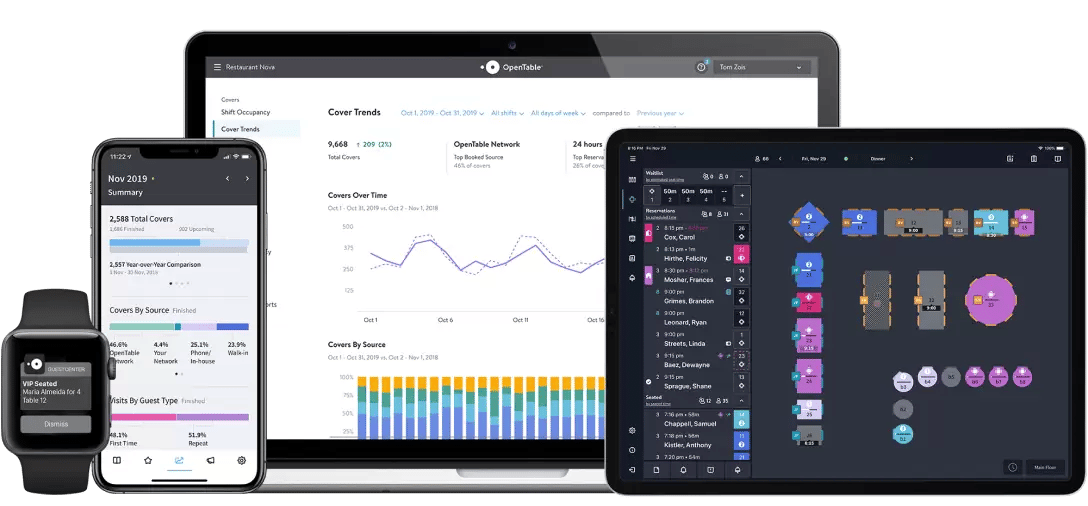
Overview: OpenTable runs the largest diner network in this list, plus reservation, table and waitlist management. Restaurants pay a monthly plan and a fee for every seated diner who books through OpenTable's site, app or affiliates.
Pros
- Largest diner network for new-guest discovery.
- You pay only for seated diners; no-shows and cancellations are not charged.
- On Core and Pro, bookings from your website and phone carry no fee.
- Experiences, takeout and diner loyalty points are included.
Cons
- $1.00 to $1.50 per seated network cover, which grows with your volume.
- A 2% service fee on prepaid experiences (all plans) and prepaid ticketing (Core and Pro).
- Table management and POS integration need Core or Pro. Updated terms require OpenTable to be your primary reservation system, as Restaurant Business reported.
Pricing (US; Basic is sold only in the US and is free for the first 30 days)
|
Plan |
Monthly |
Network cover fee |
Website cover fee |
|---|---|---|---|
|
Basic |
$149 |
$1.50 |
$0.25, or $49/mo flat |
|
Core |
$299 |
$1.00 |
None |
|
Pro |
$499 |
$1.00 |
None |
Annual rates are not public. Several regional OpenTable sites show "Contact us for pricing". See OpenTable pricing.
Guest data: Mixed. Network diners are OpenTable's customers.
Integrations: POS (Core and Pro), Google and Meta booking channels, affiliate booking network, Yelp Host AI phone answering.
Support: Phone and email; sales demos on request.
Review signal: 4.4/5 on G2 from 284 reviews (October 2026).
3. Resy
Best for: Upscale restaurants that want marketplace reach on a flat fee.
Overview: Resy is owned by American Express. Tock is now part of the Resy network, and Resy sells four plans: Platform and Platform 360 run on Resy, while Essential and Premium are "powered by Tock" (see the Tock review below).

Pros
- No per-cover fees. Resy states it charges no fee per reservation.
- Demand from Resy app users and American Express Card Members.
- Notify alerts waiting guests when a table frees up.
- Events, ticketing and walk-in waitlists on every plan.
Cons
- No free plan, no trial and no annual discount published.
- The advanced analytics dashboard needs Platform 360 ($459).
- Marketplace demand is strongest in large US cities, so value varies by market.
Pricing
|
Plan |
Monthly |
Notes |
|---|---|---|
|
Platform |
$289 |
Reservations, table management, POS integrations |
|
Platform 360 |
$459 |
Adds advanced analytics and guest insights |
Standard payment processing fees apply. See Resy pricing.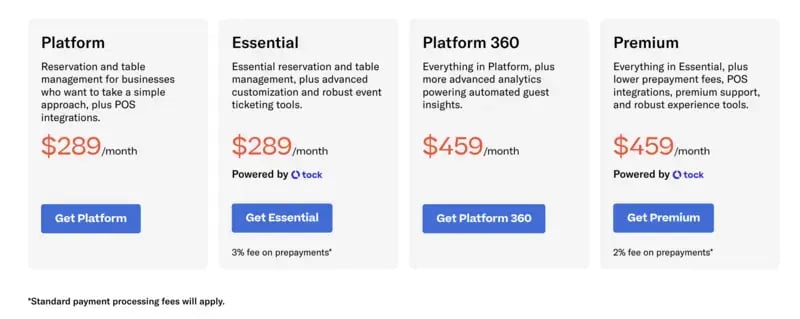
Guest data: Restaurant owns direct-booking profiles; Resy keeps its app users as its customers.
Integrations: POS integrations, plus search, AI and discovery booking channels.
Support: Chat and email on every plan; on-demand phone support for live partners on higher tiers.
Review signal: 4.1/5 on G2 from 8 reviews (October 2026).
4. Tock
Best for: Tasting menus, ticketed dinners, wineries and prepaid experiences.
Overview: American Express bought Tock from Squarespace in 2024, and Tock is now part of the Resy network. The Tock app is being retired, but Tock's software still powers Resy's Essential and Premium plans.
Pros
- Prepayments, deposits, credit card holds and ticketed experiences in one booking flow.
- Chargeback coverage on contested chargebacks, up to $25,000 a year per business.
- Exclusive booking groups let your best guests book first.
Cons
- A 3% (Essential) or 2% (Premium) fee on prepayments, on top of card processing.
- The brand is in transition: Tock venues now appear on Resy, and plans use a separate Tock help desk.
- No free plan or published annual discount.
Pricing
|
Plan |
Monthly |
Prepayment fee |
|---|---|---|
|
Essential (powered by Tock) |
$289 |
3% |
|
Premium (powered by Tock) |
$459 |
2% |
Premium adds POS integrations and premium support. See Resy pricing.
Guest data: Restaurant owns direct-booking profiles; Resy keeps its app users as its customers.
Integrations: POS on Premium; Resy discovery channels.
Support: Chat and email; premium support on Premium.
Review signal: 4.2/5 on G2 from 96 reviews (October 2026).
5. SevenRooms
Best for: Hotel groups and multi-venue restaurant groups that want deep CRM.
Overview: SevenRooms combines reservations, table management, CRM and marketing automation. It is now a DoorDash company and powers DoorDash Reservations.
Pros
- No cover fees, including on marketplace bookings from DoorDash and Deliveroo Reservations.
- Auto-tagged guest profiles and automated marketing by email and WhatsApp or text.
- Voice AI answers calls and books reservations.
- 100+ integrations, including Toast, Square, Lightspeed and NCR.
Cons
- Prices are not public; every quote goes through sales.
- Built for larger operators, so setup and training take longer than self-serve tools.
- Guests who book through DoorDash Reservations stay DoorDash's customers.
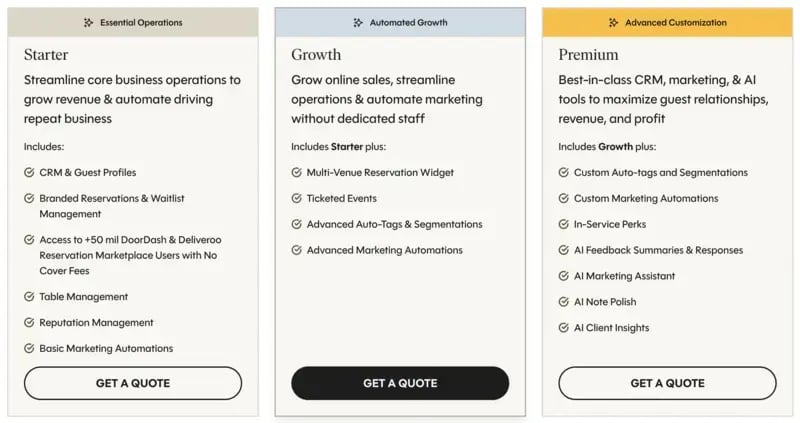
Pricing: Not public, quoted by sales. SevenRooms sells packages (Starter and up) with add-ons. Earlier versions of this guide listed $499 a month from a third-party site; we removed it because SevenRooms does not publish it. See SevenRooms pricing.
Guest data: Restaurant owns direct-booking profiles; DoorDash keeps its marketplace guests.
Integrations: Reserve with Google, Toast, Square, Lightspeed, NCR, Olo, PMS systems and an open API.
Support: 24/7, with 1:1 onboarding (vendor statement).
Review signal: 4.7/5 on G2 from 76 reviews (October 2026).
6. Yelp Guest Manager
Best for: US restaurants where Yelp drives discovery.
Overview: Yelp Guest Manager handles reservations, waitlists and table management, and takes bookings from your Yelp page. Yelp Host, a separate AI phone product, answers calls and books tables.
Pros
- Bookings from Yelp's own restaurant pages, plus Reserve with Google.
- No cover fees on any plan.
- Yelp Host answers calls 24/7 and can be bundled with Guest Manager.
Cons
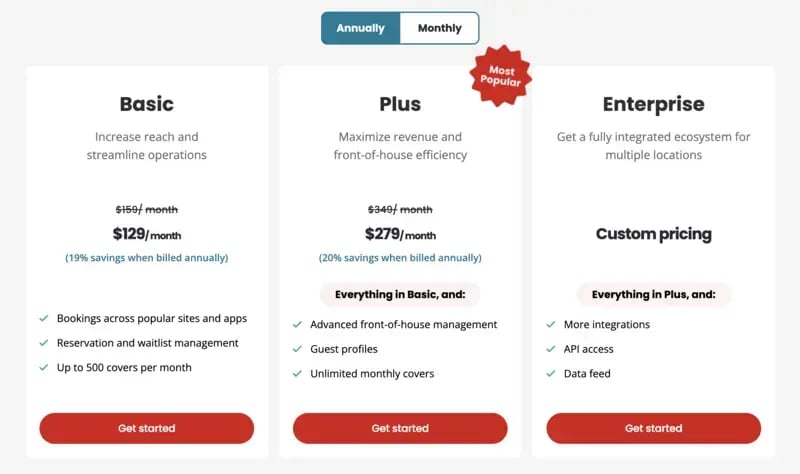
- Basic caps you at 500 covers a month, with no POS integration or guest profiles.
- Discovery value depends on how much Yelp is used in your city.
- No free plan.
Pricing
|
Plan |
Monthly |
Annual (per month) |
Limits |
|---|---|---|---|
|
Basic |
$159 |
$129 |
500 covers/mo |
|
Plus |
$349 |
$279 |
Unlimited covers, POS, guest profiles |
|
Enterprise |
Quote |
Quote |
Multi-location, API |
Yelp Host: from $249 a month. Bundle pricing with Guest Manager is quoted by Yelp. See Yelp Guest Manager pricing.
Guest data: Mixed. Yelp keeps diners who book through Yelp.
Integrations: Toast and other POS on Plus; Olo and Punchh on Enterprise; Reserve with Google.
Support: 7 days a week, 6:00 a.m. to 6:00 p.m. PT.
Review signal: 4.2/5 on G2 from 47 reviews (October 2026).
7. Toast Tables
Best for: Restaurants already on Toast POS.
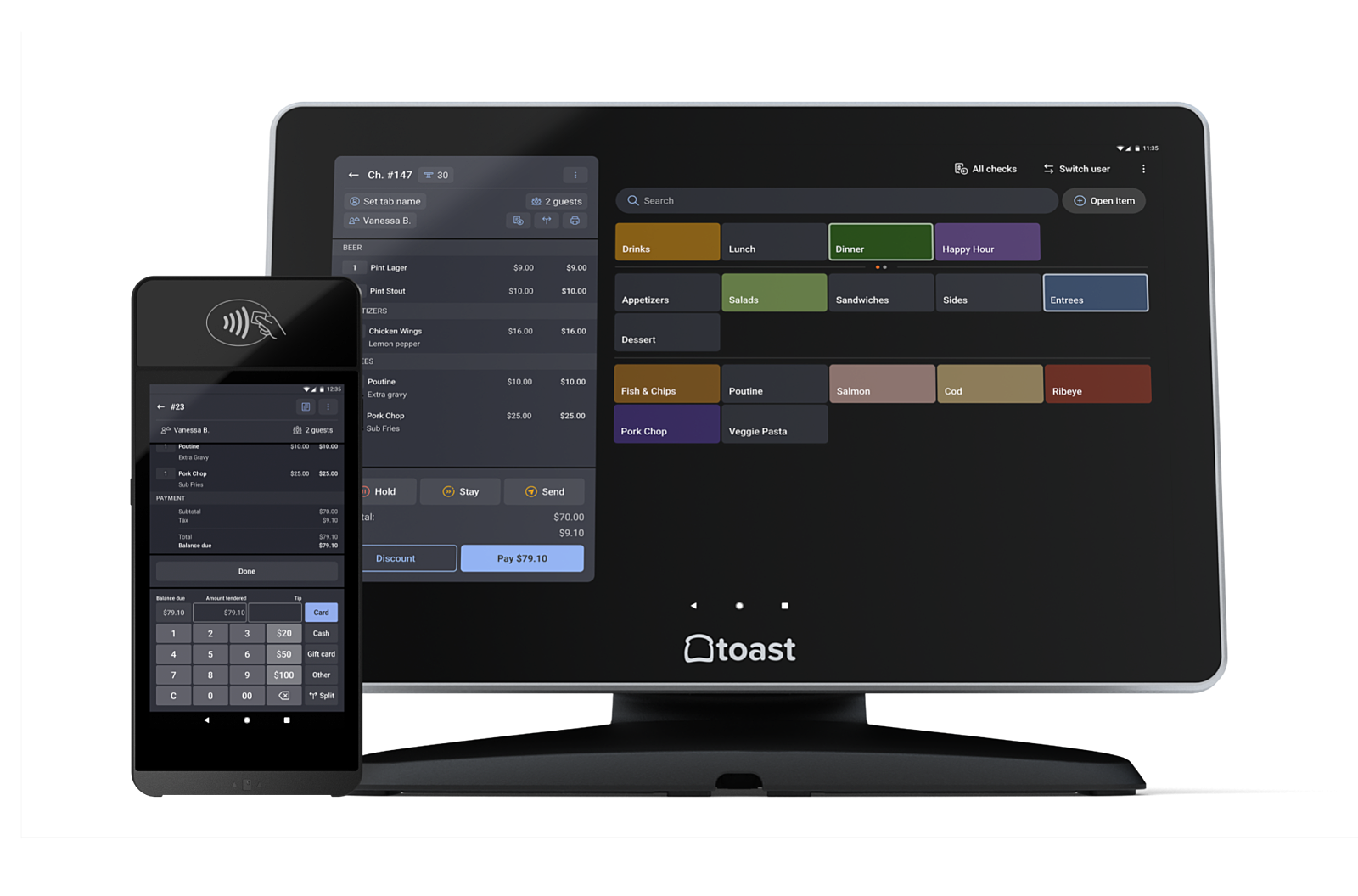
Overview: Toast Tables is a reservation and waitlist add-on for Toast POS. Bookings and table status sync with the POS in real time.
Pros
- Table status updates from the POS, so hosts see when checks close.
- Guest profiles link to order history in Toast.
- Reserve with Google bookings.
Cons
- Requires Toast POS; there is no standalone option.
- Lighter CRM and marketing than dedicated reservation systems.
- Booking pages are Toast-hosted, with limited branding.
Pricing: Not public. Toast sells two tiers as add-ons to Toast POS: Toast Tables (unlimited waitlist, 25 reservations a month) and Toast Tables Plus (unlimited reservations and Experiences). Neither carries per-cover fees. US customers add them in Toast Shop; customers in Canada, the UK and Ireland contact Toast.
Guest data: Restaurant, held in Toast.
Integrations: Toast POS, Reserve with Google.
Support: Toast customer care and the Toast support center.
Review signal: 4.2/5 on G2 from 372 reviews for Toast overall; Toast Tables has no separate G2 listing (October 2026).
8. ResDiary
Best for: UK, Irish and APAC venues that want a white-label booking experience.
Overview: ResDiary, now part of The Access Group, sells its Evo packages on a flat monthly fee with zero commission. Plans differ mainly by how many bookings you take each month.
Pros
- Commission-free bookings from your website, Reserve with Google and Meta.
- AI no-show risk prediction and an AI assistant for service insights.
- UK venues can list on DesignMyNight for extra reach.
Cons
- Booking caps on every plan except Ultimate (150, 450 and 1,000 bookings a month).
- POS integration, SMS and events are paid add-ons.
- Prices and plans vary by region; a £99 setup fee applies in the UK.
Pricing (UK, excluding 20% VAT)
|
Plan |
Monthly |
Annual |
Bookings/mo |
|---|---|---|---|
|
Evo Connect |
£109 |
£1,308 |
150 |
|
Evo Express |
£145 |
£1,450 |
450 |
|
Evo Pro |
£205 |
£2,050 |
1,000 |
|
Evo Ultimate |
£295 |
£2,950 |
Unlimited |
Add-ons: pre-orders, gift vouchers, ResPhone and Event Manager at £35 a month each; SMS, POS, PMS, CRM and group reservations at £10 a month each. A 1.2% surcharge applies to deposits and payments. See ResDiary pricing.
Guest data: Restaurant.
Integrations: POS, PMS, CRM and marketing tools (add-ons), Reserve with Google, Meta, Stripe, DesignMyNight.
Support: Local support teams by region, 7 days a week, 9:00 a.m. to 9:00 p.m.
Review signal: 4.8/5 on G2 from 5 reviews (October 2026).
9. Hostme
Best for: US independents that want reservations, waitlist and events on one flat fee.
Overview: Hostme combines reservations, waitlist, table management, events, a guestbook and online ordering. It suits full-service restaurants, bars, breweries, and wineries.

Pros
- Flat monthly price with unlimited parties and no per-cover fees.
- Unlimited SMS and WhatsApp messages on paid plans.
- Deposits and cancellation fees to reduce no-shows.
Cons
- Small diner network compared with the big marketplaces.
- POS integration only on Grande.
- Bookings from Tripadvisor and the Michelin Guide cost $2.50 per cover; Facebook and Instagram booking costs $15 a month. Extra events cost $20 each.
Pricing
|
Plan |
Monthly |
Annual (per month) |
Includes |
|---|---|---|---|
|
Mezzo |
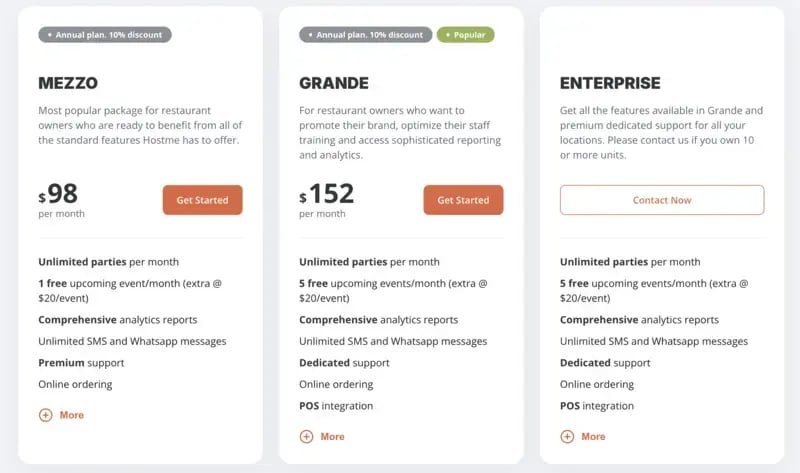
$109 |
about $98 |
1 free event/mo |
|
Grande |
$169 |
about $152 |
5 free events/mo, POS integration |
|
Enterprise |
Quote |
Quote |
10+ locations |
14-day free trial, no credit card. See Hostme pricing.
Guest data: Restaurant.
Integrations: Reserve with Google, Lightspeed and Square POS (Grande).
Support: Premium support on Mezzo; dedicated support on Enterprise.
Review signal: 4.5/5 on G2 from 4 reviews (October 2026).
10. TheFork
Best for: Restaurants in France, Italy, Spain and other European markets where TheFork drives bookings.
Overview: TheFork is a European diner marketplace with more than 50,000 partner restaurants in 11 countries. American Express agreed in June 2026 to buy it from Tripadvisor for $700 million, with the deal expected to close by the end of 2026. TheFork Manager is its reservation and table management software.
Pros
- Large European diner audience, with listings on partner channels such as Tripadvisor.
- Commission-free bookings through your own website and social widget.
- Gift cards and an in-restaurant payment tool.
Cons
- A commission per cover on bookings from TheFork and partner channels.
- Prices are not published and vary by country.
- Diners who book on TheFork stay TheFork's customers.
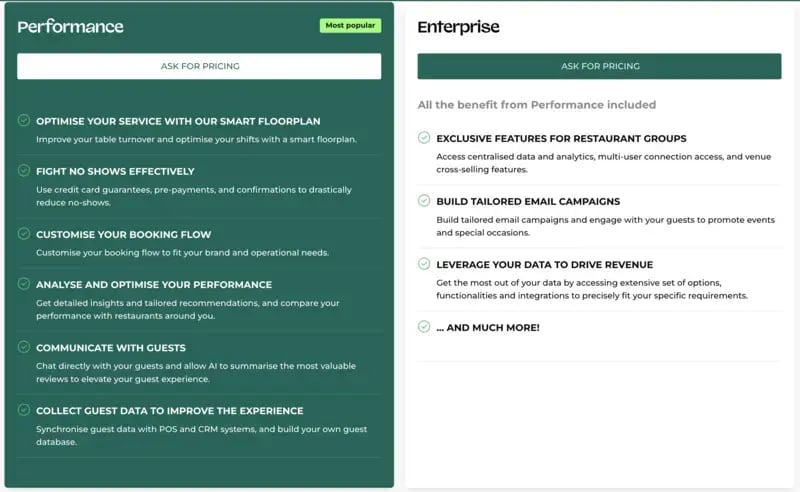
Pricing: Not public, quoted by sales. A monthly subscription plus a commission per cover on marketplace bookings.
Guest data: Mixed.
Integrations: Tripadvisor and partner channels, Google. POS varies by market.
Support: Dedicated account manager (vendor statement).
Review signal: 5.0/5 on G2 from 1 review for TheFork Manager (October 2026).
11. Servme
Best for: Restaurants and hotel F&B in the Middle East and North Africa.
Overview: Servme is a Dubai-based reservation, CRM and marketing platform. Its account managers set up floor plans and migrate data before go-live.

Pros
- Guest CRM, profiles and a dedicated account manager on every plan.
- Free setup and data migration; most venues go live within a week.
- Commission-free bookings from Tripadvisor, Zomato and Google.
Cons
- A 1% fee on payment deposits and pre-authorizations.
- Published prices are billed annually; there is no published monthly option.
- POS integration only on Advanced ($299); PMS, telephone and WhatsApp integrations are add-ons.
Pricing
|
Plan |
Per venue per month, billed annually |
Adds |
|---|---|---|
|
Starter |
$129 |
Reservations, waitlist, table management, guest CRM, booking widget, multi-channel booking |
|
Essential |
$199 |
Marketing templates, automated guest tags, surveys, review management, source tracking, event upselling |
|
Advanced |
$299 |
POS integration, multi-venue reservations, advanced reporting, payment groups |
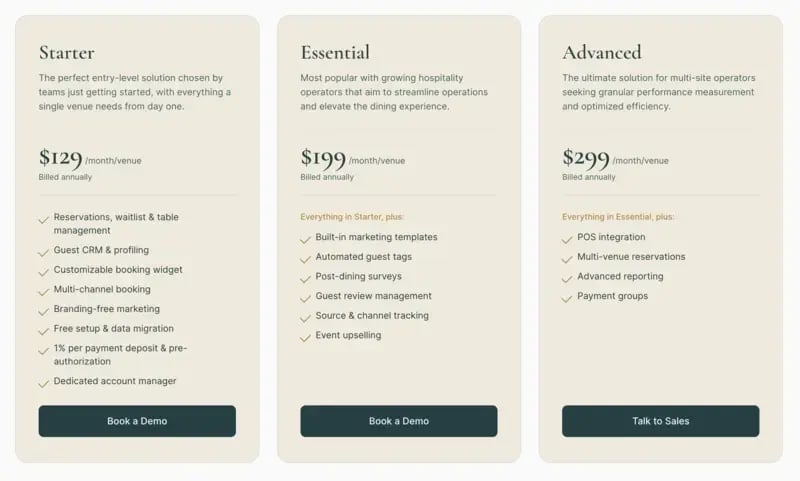
Guest data: Restaurant.
Integrations: POS (Advanced); PMS, Oracle Opera, telephone caller ID and WhatsApp as add-ons; Tripadvisor, Zomato and Google booking channels.
Support: Account manager onboarding; most venues go live within a week (vendor statement).
Review signal: 4.8/5 on G2 from 2 reviews (October 2026).
12. Tablein
Best for: Small European restaurants with predictable booking volume.
Overview: Tablein is a booking system with a floor plan, timeline and guest notifications. Every plan includes all features and a free reservation website; plans differ by the number of bookings.

Pros
- All features on every plan, including prepayments, guest book and feedback.
- A free reservation website plus an embeddable widget.
- Discounts for groups with two or more locations.
Cons
- Starter includes only 50 bookings a month; extra bookings cost €0.67 each (€0.37 on Growth).
- No free plan, only a 14-day trial.
- Limited CRM and integrations.
Pricing (per restaurant)
|
Plan |
Monthly |
Bookings/mo |
Over the limit |
|---|---|---|---|
|
Starter |
€67 / £60 / $79 |
50 |
€0.67 per booking |
|
Growth |
€117 / £105 / $139 |
150 |
€0.37 per booking |
|
Success |
€177 / £157 / $209 |
Unlimited |
None |
Annual billing on Success: pay for 10 months, get 12.
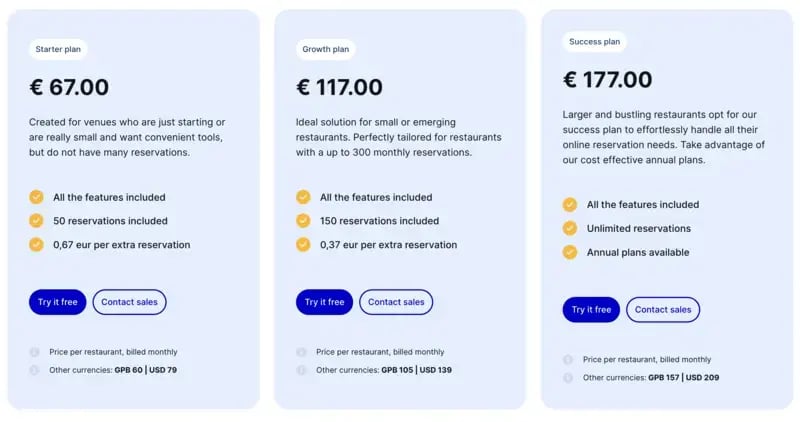
Guest data: Restaurant.
Integrations: Reserve with Google (commission-free), website widget, Tablein restaurant guides in selected markets. No POS integration listed.
Support: Free email and live chat support, plus free online training.
Review signal: No G2 reviews yet; 5.0/5 on Capterra from 21 reviews (October 2026).
13. resOS
Best for: Cafés, bars and very small restaurants.
Overview: resOS is a Danish booking system with a visual table planner and online booking widget. Every plan has all core features; you pay by booking volume.
Pros
- Free forever up to 25 bookings a month, no credit card.
- No per-booking, per-cover or commission fees.
- Free human support on every plan.
Cons
- Some channels and tools are paid add-ons, such as online payments (€11.99 a month).
- The free plan's 25-booking limit suits only very small venues.
- Few POS integrations compared with larger platforms.
Pricing
|
Plan |
Monthly |
Bookings/mo |
|---|---|---|
|
Free |
$0 |
25 |
|
Basic |
$47 |
350 |
|
Plus |
$98 |
750 |
|
Unlimited |
$149 |
Unlimited |
Billed annually: $37, $78 and $119 a month. Add-ons from €7.99 to €19.99 a month. See resOS pricing.
Guest data: Restaurant.
Integrations: Google reservations (add-on), Facebook, Instagram, Stripe payments (add-on).
Support: Free personal support on every plan, including Free.
Review signal: No G2 reviews yet (October 2026).
14. Table Agent
Best for: Restaurants that need basic online booking at no cost.
Overview: Table Agent is a free, web-based reservation system with a booking widget, reservation dashboard, waitlist, and basic table controls. Restaurants are listed on Table Agent's consumer site by default.

Pros
- Core reservations are free: no setup, monthly, booking or per-customer fees.
- Waitlist and table controls, including table groups for joined tables.
- Simple flat fee for online payments if you need deposits.
Cons
- Basic CRM and reporting compared with paid systems.
- SMS confirmations and payments cost extra.
- Your restaurant is listed on Table Agent unless you pay $30 a month for an unlisted account.
Pricing
|
Item |
Monthly |
|---|---|
|
Core reservations |
$0 |
|
Online payments (unlimited transactions) |
$29 |
|
SMS texting (Premium) |
From $29 |
|
Unlisted account |
$30 |

Guest data: Mixed: listed restaurants appear on Table Agent's diner site.
Integrations: Website widget. No POS integration found.
Support: Phone and email.
Review signal: 5.0/5 on G2 from 1 review (October 2026).
AI and phone reservations
AI voice agents now answer restaurant phones, check live availability and write the booking straight into the reservation system. They suit restaurants that miss calls during service or after hours.
What an AI voice agent does:
- Answers every call, including several at once.
- Books, changes and cancels reservations against real table availability.
- Answers common questions such as hours, parking and dietary options.
- Hands complex calls, such as large events or complaints, to staff.
Which systems offer it:
|
System |
AI phone option |
Cost |
|---|---|---|
|
Eat App |
Voice AI through Millie AI and MyAutobot, synced to the Eat App diary; AI assistant, chatbot and upseller in the Core and Pro AI packages |
AI packages included on Core and Pro, some features usage-based; voice partners priced separately |
|
SevenRooms |
Built-in Voice AI |
Quoted by sales |
|
Yelp Guest Manager |
Yelp Host |
From $249/mo; bundle pricing with Guest Manager on request |
|
OpenTable |
Works with Yelp Host and third-party voice agents |
Partner pricing |
|
ResDiary |
ResPhone add-on for calls you cannot answer |
£35/mo |
When it makes sense: if you take more than a few dozen calls a week, or regularly miss calls during peak service. It makes less sense if most of your guests already book online.
What to check before you buy: that the agent writes to your reservation system in real time, how it handles allergies and large groups, and whether call recording rules in your country require a disclosure message.
Which reservation system should you choose?
- Choose Eat App if you want a free start, flat commission-free pricing, WhatsApp messaging and your own guest CRM.
- Choose OpenTable if you need new diners fast and the per-cover fees fit your margins.
- Choose Resy if you run an upscale venue and want marketplace reach on a flat monthly fee.
- Choose Tock (Resy Essential or Premium) if you sell tasting menus, ticketed dinners or prepaid experiences.
- Choose SevenRooms if you run a hotel or multi-venue group and want deep CRM with a sales-led setup.
- Choose Yelp Guest Manager if Yelp drives most of your local discovery in the US.
- Choose Toast Tables if you already run Toast POS and want bookings that sync with it.
- Choose ResDiary if you are in the UK or APAC and want a white-label, commission-free system.
- Choose Hostme if you want reservations, waitlist and events on one flat US price.
- Choose TheFork if TheFork brings a large share of your guests in Europe.
- Choose Servme if you operate in the Middle East and want account-managed onboarding.
- Choose Tablein if you are a small European restaurant with steady, predictable bookings.
- Choose resOS if you take fewer than 25 bookings a month, or want a low flat fee.
- Choose Table Agent if you need basic online booking and have no budget.
Best reservation software by country
Reservation pricing, local competitors and guest-messaging habits vary a lot by market. These country guides cover the platforms, real local pricing and buying considerations for each:
- Best reservation software in the United States: per-cover network fees explained
- Best reservation software in Canada: CAD pricing and Quebec French-language booking
- Best reservation software in Singapore: marketplace fees and PDPA data ownership
- Best reservation software in the Philippines: WhatsApp confirmations and peso pricing
- Best reservation software in Indonesia: WhatsApp-first booking and group deposits
- Best reservation software in France: commissions par couvert et RGPD (French)