


.svg)
.svg)


















.svg)

.svg)


.png?width=200&name=Untitled%20design%20(20).png)
-1.png?width=200&name=Untitled%20design%20(19)-1.png)
-1.png?width=1812&height=1072&name=TripAdvisor%20%26%20More%20Bookings%20(1)-1.png)
-2.png?width=1812&height=1072&name=Google%20Bookings%20(1)-2.png)
-1.png?width=200&name=Untitled%20design%20(18)-1.png)
-1.png?width=200&name=Untitled%20design%20(17)-1.png)
-1.png?width=200&name=TripAdvisor%20%26%20More%20Bookings%20(1)-1.png)
-2.png?width=200&name=Google%20Bookings%20(1)-2.png)
-1.png?width=200&name=Instagram%20Bookings%20(1)-1.png)
-1-png.webp?width=200&name=Facebook%20Integration%20Rectangle%20(1)-1-png.webp)






.webp?width=200&name=download%20(1).webp)
%20(1)-2.webp?width=200&name=Eat%20(34)%20(1)-2.webp)
%20(1)-2.webp?width=200&name=Eat%20(18)%20(1)-2.webp)







The restaurant reservation software landscape looks very different in 2026 than it did even a year ago.American Express merged Tock into Resy in February 2026 creating a combined platform serving roughly 25,000 venues. DoorDash acquired SevenRooms for $1.2 billion and OpenTable continues to dominate with 60,000+ restaurants and per-cover fees that keep climbing.
In the middle of all this consolidation a real question has emerged for operators, do you want your reservation system owned by a credit card company, a delivery app or a legacy marketplace? Or would you rather own the relationship yourself?
That's the core tension in the Resy vs Eat App comparison. Both are capable platforms.Both serve restaurants that care about the guest experience. But they come from fundamentally different philosophies and for most operators that philosophical difference has very practical consequences for pricing, data ownership, marketing capability and global flexibility.
This guide breaks down everything you need to know to make the right decision for your restaurant.
What changed in 2026: The Resy–Tock Merger, Explained
Before we dive into the comparison it's worth understanding what's happening at Resy right now because it directly affects any restaurant evaluating the platform.
American Express acquired Resy in 2019 and Tock for $400 million in 2024. In February 2026, Amex officially merged the two platforms under the Resy brand.Tock's website and standalone app are being sunsetted, and its ticketed-experience and prepayment capabilities are being folded into Resy's reservation system.
For operators this merger means several things.On the positive side, Resy now offers event ticketing and prepaid experiences features it previously lacked.The combined restaurant network is larger, giving diners more choice.
On the other hand, the merger deepens restaurants' dependence on a single corporate ecosystem.Your reservations, your events, your guest data and increasingly your marketing reach are all flowing through AmEx-owned infrastructure.For operators who value independence and full data ownership that's a real consideration and it's one of the reasons more restaurants are evaluating Resy competitors like Eat App.
Resy vs Eat App at a Glance
| Feature | Resy (by American Express) | Eat App |
| Starting price | $249/mo (Platform plan) | $0/mo (permanent free plan) |
| Free plan | No | Yes, reservations, floor plan, table management |
| Per-cover fees | None | None |
| G2 rating | 4.1/5 (7 reviews) | 4.5/5 (45+ reviews) |
| Capterra rating | 4.5/5 (20 reviews) | 4.5/5 (20+ reviews) |
| Guest CRM | Basic profiles with notes and tags | Advanced CRM with segmentation, spend tracking, and campaign tools |
| Marketing automation | None built-in | Email, SMS, and WhatsApp automation |
| POS integrations | Toast, Square, NCR Aloha, Micros | 30+ POS systems including Toast, Square, Lightspeed, Oracle, Foodics |
| Countries served | Primarily US; limited international (London, select cities) | 90+ countries: Middle East, Europe, APAC, North America |
| Target market | Upscale independent restaurants in major US cities | Independent to enterprise: hotels, chains, fine dining, casual |
| Device requirements | iPad only (historically) | iPad, Android, iOS, web browser |
| Contract requirements | Annual contracts typical | Month-to-month; cancel anytime |
| Discovery platform | Resy app/website (50M+ users) | Eat App diner network |
| Parent company | merican Express | Independent (VC-backed, $16M raised) |
Pricing Comparison: What Restaurants actually pay
One of the biggest surprises for operators evaluating Resy is how quickly costs escalate beyond the headline subscription price.Let's break down what restaurants actually pay across both platforms.
Table 2: Full Pricing Breakdown
| Cost Element | Resy Platform | Resy Platform 360 | Eat App Free | Eat App Starter | Eat App Pro | Eat App Enterprise |
| Monthly subscription | $249 | $399 | $0 | ~$49 | ~$139 | ~$239 |
| Annual cost | $2,988 | $4,788 | $0 | ~$588 | ~$1,668 | ~$2,868 |
| POS integration | Included in Platform 360; ~$100/mo add-on on Platform | Included | N/A | Add-on ~$129/mo | Add-on ~$129/mo | Included |
| Event/ticketing fees | 2–3% per prepayment | 2% per prepayment | N/A | N/A | N/A | N/A |
| Per-cover fees | None | None | None | None | None | None |
| Free trial | No | no | Permanent free plan | 14-day trial | 14-day trial | Demo available |
| Contract | Annual typical | Annual typical | None | Month-to-month | Month-to-month | Flexible |
What This Means in Real Numbers
Consider a restaurant doing 300 covers per month that needs reservations, CRM, marketing automation and POS integration.
With Resy Platform 360, you're paying $399/month roughly $4,788 per year.If you run ticketed events and collect $50,000 in prepayments annually, add another $1,000–$1,500 in transaction fees.Total realistic annual cost: $5,800–$6,300.
With Eat App Pro + POS integration, you're paying approximately $268/month roughly $3,216 per year. No event transaction fees. No annual contract.Total realistic annual cost: $3,216.
That's a $2,500–$3,000 annual saving and you get marketing automation (WhatsApp, SMS, email campaigns) that Resy doesn't include at any price tier.
Feature-by-Feature comparison
This is where the Resy vs Eat App comparison gets granular. Both platforms handle the fundamentals online reservations, floor plans and waitlists.The differences emerge in CRM depth, marketing tools, AI capabilities and integration breadth.
Table 3: Feature Matrix
| Feature | Resy | Eat App |
| Online reservations | ✅ | ✅ |
| Table Management | ✅ | ✅ |
| Customisable floor plan | ✅ | ✅ |
| Digital waitlist | ✅ | ✅ |
| Guest CRM profiles | ✅ | ✅ |
| Guest segmentation & tagging | Basic | ✅ Advanced |
| Email marketing campaigns | ❌ | ✅ |
| SMS marketing campaigns | ❌ | ✅ |
| Whatsapp messaging | ❌ | ✅ |
| Loyalty program | ❌ | ✅ |
| No-Show prediction (AI) | ❌ | ✅ |
| Smart wait time estimation (AI) | ❌ | ✅ |
| Automated post-dining surveys | ❌ | ✅ |
| Review management | ❌ | ✅ |
| Event ticketing | ✅ (via Tock merger) | ❌ |
| Pay at table | ❌ | ✅ |
| Multi-location dashboard | ✅ | ✅ |
| 3D floor-plan tours | ❌ | ✅ |
| API access | ✅ | ✅ |
| White -label booking widget | Limited | ✅ Full customisation |
| Phone system integration (PBX) | ❌ | ✅ |
That's 8 major features Eat App offers that Resy doesn't including the entire marketing automation stack, loyalty tools, AI-powered operations and phone system integration.Resy's standout addition is event ticketing through the Tock merger, a capability Eat App doesn't currently offer.
Let's dig deeper into the categories that matter most.
Reservations and Table Management
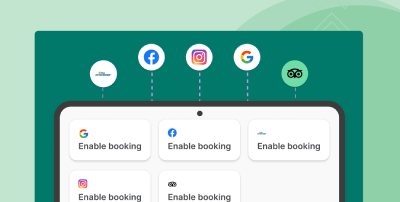
Both platforms handle online reservations competently.Resy accepts bookings through its consumer app, restaurant websites and Google Reserve.Eat App does the same through branded widgets, Google, Instagram and Facebook.
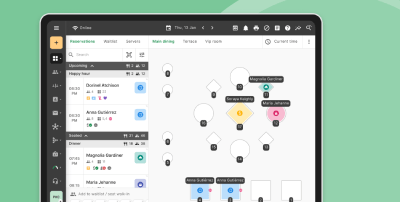
Where they diverge is in operational flexibility.Eat App offers automatic table assignment that intelligently seats guests based on party size and floor plan configuration.Resy's pacing controls work by cover count only not by individual table which has been a long-standing frustration for operators who've requested table-level pacing.
Eat App also supports both iPad and Android devices, plus web browser access. Resy has historically required iPads for front-of-house use, though browser access has improved.
For waitlist management, Resy's "Notify" feature which alerts guests when tables open at fully booked restaurants is genuinely best-in-class and one of the platform's strongest differentiators. Resy reports an industry-low no-show rate of 2.3–3.8%, partly attributed to this feature.
Eat App counters with AI-powered smart wait time estimation and no-show prediction, using historical data to help hosts make better decisions about seating and overbooking. One multi-venue operator on G2 noted that Eat App's "AI‑driven seating logic helps maximize table turns across even complex floor plans, so we fill more seats intelligently." Another reviewer praised the platform for solving "table and floor management issues" by providing "real-time table availability and optimized seating."
Edge: Tie - Resy's Notify feature is exceptional for high-demand restaurants, Eat App offers more operational flexibility and AI-powered tools.
Guest CRM and Data Ownership
This is where the comparison gets decisive and where the best restaurant reservation software debate gets real.
Resy provides guest profiles with biographical details, dietary preferences, special occasions, tags and visit history.This data is shared across all restaurants in a group, which is useful for multi-venue operators.The platform also recently added integrations with Fishbowl and Loyalist for external CRM capabilities.
However, Resy's CRM has three significant limitations. First, there's no built-in marketing automation no email campaigns, no SMS blasts, no automated re-engagement sequences.Second, guest data access is month-to-month rather than permanent restaurants don't have sole ownership of their guest data. Third, guest communications are Resy-branded rather than restaurant-branded, which limits your ability to build a direct relationship with diners.
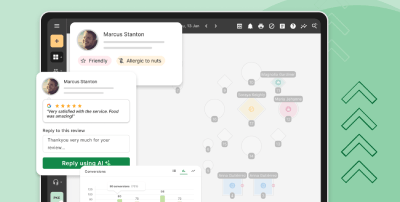
Eat App's CRM is built from the ground up as a revenue-driving tool.Guest profiles capture visit history, spend data (via POS integration), dietary notes, custom tags, staff notes and automated feedback from post-dining surveys.From that data, you can build segments and trigger campaigns automatically — birthday offers, "we miss you" messages for lapsed guests, VIP invitations, review requests linked to your Google Business profile.
The data ownership model is fundamentally different. With Eat App, restaurants own 100% of their guest data. Full GDPR and CCPA compliance is built in, with consent tracking, data deletion tools and two-factor authentication.
A G2 reviewer managing a multi-venue F&B group described the impact in practical terms: the "layered guest CRM and tagging allow personalized hospitality we can automate birthday messages, identify VIPs and refine promotions for different segments." The same reviewer highlighted the "reporting dashboard" that lets them "slice data by location, shift, guest spend, or marketing channel" insights they use to guide operational decisions and boost revenue per cover.
Another operator on G2 specifically noted that the "centralised CRM" was useful for "email campaigns and WhatsApp marketing blasts," and that after comparing Eat App against vendors like SevenRooms, they found Eat App "diverse in its features and competitively priced" with SevenRooms costing significantly more for similar functionality.
Edge: Eat App - significantly deeper CRM with full data ownership and built-in marketing automation.
Marketing Automation: WhatsApp, SMS and Email
This is the starkest gap in the Resy vs Eat App comparison.
Resy offers two-way SMS communication for reservation confirmations and reminders. Beyond that, there is no marketing automation built into the platform. No email campaigns, no promotional SMS, no WhatsApp messaging, no automated re-engagement sequences.If you want to market to your guests, you need third-party tools and you need to export your data which, as noted above, you access on a month-to-month basis rather than owning outright.
Eat App includes a full marketing automation suite across all paid plans. You can build and send email campaigns using built-in templates, run SMS campaigns to targeted guest segments, and critically for restaurants in the Middle East, Europe and Asia send WhatsApp messages directly from the platform. Automated workflows handle post-dining surveys, review requests, birthday greetings and lapsed-guest re-engagement without manual effort.
For restaurants that understand guest marketing isn't optional anymore it's how you fill seats on slow nights and turn first-timers into regulars this gap alone can justify switching platforms.
One Eat App user summarised this on G2 by calling the platform "a game-changer for managing multiple restaurants on autopilot," specifically praising "CRM, automation, and multi-channel bookings" as the features that deliver the most value. Another reviewer highlighted how Eat App solved the problem of "inefficient communication" by automating "SMS/email confirmations" and allowing "quick updates" functionality that replaced hours of manual phone follow-ups.
Edge: Eat App - Resy has no marketing automation, Eat App includes email, SMS and WhatsApp campaigns with behaviour-based triggers.
Integrations and POS Compatibility
Both platforms integrate with major POS systems but the breadth and flexibility differ significantly.
Table 4: Integration and Platform Comparison
| Integration | Resy | Eat App |
| Toast POS | ✅ | ✅ |
| Square POS | ✅ | ✅ |
| Lightspeed POS | ❌ | ✅ |
| Oracle Micros | ✅ | ✅ |
| NCR Aloha | ✅ | ✅ |
| Foodics | ❌ | ✅ |
| Revel | ❌ | ✅ |
| Clover | ❌ | ✅ |
| Google Reserve | ✅ | ✅ |
| Instagram Reserve | ✅ | ✅ |
| ✅ | ✅ | |
| Stripe | ❌ | ✅ |
| HubSpot | ❌ | ✅ |
| Phone system (PBX) | ❌ | ✅ |
| PMS (hotel property mgmt) | ❌ | ✅ |
| iPad | ✅ | ✅ |
| Android | Limited | ✅ |
| Web browser | ✅ | ✅ |
Eat App integrates with 30+ POS systems compared to Resy's handful. For hotel groups that need PMS connectivity or restaurants using regional POS systems like Foodics (popular in the Middle East) or Revel, Eat App's integration ecosystem is substantially broader.
Eat App's phone system integration is also unique it connects caller ID data directly to guest profiles so when a regular calls, your host immediately sees their name, visit history, preferences and notes. Resy doesn't offer this capability.
A G2 reviewer running multiple restaurant locations called out Eat App's integration depth, noting that "seamless integrations, unlimited messaging, and advanced automation" in the Enterprise plan give operators "absolute control over a multi-venue operation."The reviewer also highlighted how POS-connected spend data flows into guest profiles, enabling targeted campaigns that would require separate third-party tools on Resy.
Edge: Eat App - broader POS support, PMS integration for hotels and unique phone system connectivity.
Who should choose Resy
Resy is the right choice if your restaurant matches this profile:
You're an upscale independent restaurant in a major US city New York, LA, San Francisco, Miami, Chicago or Washington DC. Your diners are the type who use the Resy app to discover new restaurants, and access to Resy's 50-million-user discovery platform matters to your bottom line. You want the AmEx cardholder benefits the Global Dining Access programme, Platinum Card dining credits and VIP diner identification because your guest profile skews toward high-spending premium cardholders.You host ticketed dining experiences and need integrated prepayment and event management (now enhanced through the Tock merger). Your operation is US-focused, you use an iPad-based setup and you don't need marketing automation built into your reservation system because you handle guest marketing through separate tools.
In this scenario Resy's combination of brand cachet, discovery reach and AmEx integration is genuinely hard to replicate.
Who should choose Eat App
Eat App is the right choice if your restaurant matches any of these profiles:
You want a free plan to start not a demo not a trial but a permanent free tier with real reservations and table management. You need guest CRM that actually drives revenue with segmentation, spend tracking, WhatsApp/SMS/email marketing, automated surveys and loyalty tools built into one dashboard.You operate outside the US in the Middle East, Europe, Southeast Asia, APAC or across multiple international markets and need a platform that works everywhere.You run a hotel F&B group or multi-location chain and need a centralised dashboard with PMS integration and cross-venue guest data.You want transparent pricing with no annual contracts, no auto-renewals and no hidden add-on fees that double your bill. You value full data ownership your guest data belongs to you not to a credit card company's ecosystem.
The fundamental difference: Resy is designed to serve American Express's dining ecosystem.Eat App is designed to serve your restaurant.
What real users Say
User reviews across G2, Capterra and app stores reveal consistent patterns for both platforms.
What operators love about Resy
Resy's Notify feature which alerts diners when a table opens at a fully booked restaurant is consistently praised as the platform's strongest capability. Operators also appreciate the intuitive interface, quick setup process and responsive customer support team.The AmEx-driven diner discovery is valuable for restaurants in competitive urban markets.
What operators criticise about Resy
The most frequent criticisms centre on limited CRM and data access, app instability (multiple App Store reviews mention "lock timeout fail" errors and loading issues), the lack of a blacklist feature (widely requested by fine-dining operators) and pacing limitations (cover-based only, not table-based).Several operators have noted a perceived innovation slowdown since the AmEx acquisition, with one restaurant group owner stating publicly that the product has "gotten unbelievably bad" since the buyout.
What operators love about Eat App
Users consistently praise Eat App's ease of use and rapid setup (one reviewer rated it "10 out of 10 for setup ease") the depth of CRM and automation tools, the proactive support team that engages through conference calls rather than just ticket queues and the value for money compared to competitors.Multi-venue operators specifically highlight the centralised dashboard and cross-location guest tracking.
What operators criticise about Eat App
The most common criticisms include limited brand awareness in the US market (several reviewers noted the platform isn't well-known stateside), occasional POS integration challenges during initial setup and a back-end admin interface that some find less polished than the front-of-house experience.However reviewers consistently note that the support team addresses issues quickly when they arise.
Beyond the US: Why global operators choose Eat App
This section matters for any restaurant group operating outside major American cities which is the vast majority of restaurants worldwide.
Resy's strength is concentrated in a handful of US metros. Its international presence is limited primarily to London with scattered coverage in select global cities through the AmEx partnership. If you run restaurants in Dubai, Singapore, Sydney, Beirut, Riyadh, Mumbai or anywhere across Europe and APAC, Resy simply isn't built for your market.
Eat App operates in 90+ countries and is the reservation platform of choice for global hospitality brands including The Ritz-Carlton Group, Fairmont Hotels and Four Seasons.It's headquartered in Dubai with offices in the US and India, and its platform supports the regional POS systems, payment gateways and communication channels (particularly WhatsApp, which is essential in the Middle East and much of Asia) that global operators depend on.
For a hotel group running F&B outlets across Dubai, London and New York, Eat App provides a single centralised dashboard across all locations. With Resy your New York venues might be covered, but your international properties would need an entirely separate system fragmenting your guest data and doubling your operational complexity.
Making the switch: How to migrate from Resy to Eat App
If you're considering moving from Resy to Eat App here's what the process typically looks like.
Step 1: Export your data. Request a guest database export from Resy during your off-boarding process.This should include guest names, contact details, visit history and any notes or tags you've added.
Step 2: Set up Eat App. Sign up for the free plan (no credit card required) and configure your floor plan, shift settings and booking widget.Most restaurants are live within a few hours.
Step 3: Import your guest data. Eat App's support team assists with importing your existing guest database during onboarding, ensuring profiles, preferences and history carry over.
Step 4: Run parallel. Many restaurants run both systems simultaneously for 1–2 weeks to ensure a smooth transition before fully switching over.
Step 5: Activate marketing. Once your guest data is in Eat App, set up automated campaigns welcome messages, post-dining surveys and re-engagement sequences to start driving repeat visits immediately.
The Bottom line: Resy vs Eat App
Resy is a strong discovery-driven reservation platform for upscale US restaurants that want access to American Express's diner network and cardholder benefits. If your restaurant thrives on being part of a curated, trendy dining ecosystem in New York, LA, or Miami and you don't need built-in marketing automation or global coverage, Resy delivers genuine value.
Eat App is the better choice for restaurants that want to own their guest relationships end-to-end. Deeper CRM, built-in marketing across email, SMS, and WhatsApp, broader POS integrations, global multi-location support, AI-powered operations, and transparent pricing starting at $0/month make it the more complete platform for operators who see their reservation system as a revenue engine — not just a booking tool.
The question isn't which platform takes reservations better.They both do that well. The question is: what happens after the reservation is made? That's where Eat App pulls ahead.
Start Free: No Cover Fees, Ever
Ready to see how Eat App compares to Resy for your specific restaurant? Start with our free plan no credit card, no cover fees, no annual contract.
Get started with Eat App's free trial

Join 5,000+ restaurants in 90+ countries using Eat App to manage reservations, build guest loyalty, and grow revenue on their own terms.
.png?width=670&height=440&name=Untitled%20design%20(20).png)


.webp?width=144&height=72&name=Eat%20App%20Logo%20(3).webp "Eat App")