


.svg)
.svg)
















.svg)

.svg)


-2-1.webp?width=200&name=image5%20(6)-2-1.webp)
%20(1)-1.webp?width=200&name=Eat%20(57)%20(1)-1.webp)
-1.png?width=1812&height=1072&name=TripAdvisor%20%26%20More%20Bookings%20(1)-1.png)
-2.png?width=1812&height=1072&name=Google%20Bookings%20(1)-2.png)
%20(1)-1.webp?width=200&name=Eat%20(62)%20(1)-1.webp)

-1.png?width=200&name=TripAdvisor%20%26%20More%20Bookings%20(1)-1.png)
-2.png?width=200&name=Google%20Bookings%20(1)-2.png)
-1.png?width=200&name=Instagram%20Bookings%20(1)-1.png)
-1-png.webp?width=200&name=Facebook%20Integration%20Rectangle%20(1)-1-png.webp)






.webp?width=200&name=download%20(1).webp)
%20(1)-2.webp?width=200&name=Eat%20(34)%20(1)-2.webp)
%20(1)-2.webp?width=200&name=Eat%20(18)%20(1)-2.webp)







If you've been running your restaurant on Libro or you're mid-research and weighing your options you already know the appeal.Commission-free pricing, a clean interface and a Canada-first approach to restaurant booking software that makes sense for independent operators who are tired of handing a cut of every cover to legacy platforms.
We built Eat App on the same principle: Restaurants shouldn't bleed revenue just to take reservations.
But if you're here, something's making you look around.Maybe you're expanding beyond Canada.Maybe you've hit the ceiling on Libro's CRM and marketing capabilities or maybe you just want to see what else is out there before you commit to another year.
Whatever brought you here, let's lay out the facts so you can make the right call for your restaurant.
Libro vs Eat App: A Quick comparison
|
Feature |
Libro | Eat App |
| Pricing model | Flat-rate subscription (from ~$119/mo) | Flat-rate subscription (from $0/mo) |
| Cover fees | None | None |
| Free plan | No | Yes, with reservations, table management, and floor plan |
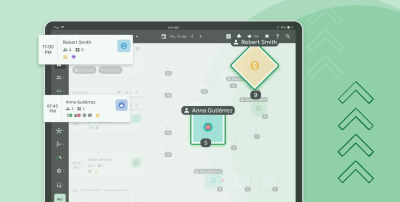
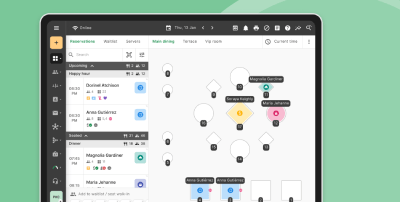
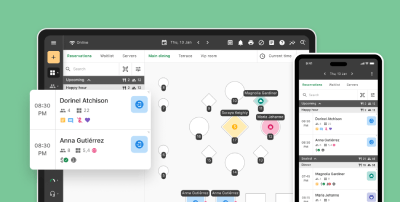
| Table management | Yes, color-coded floor plan | Yes, real-time interactive floor plan with auto-assign |
| Guest CRM | Basic guest profiles and notes | Advanced CRM with tags, segmentation, spend tracking and campaign tools |
| Marketing tools | Email and SMS campaigns | Email, SMS and WhatsApp campaigns with automation |
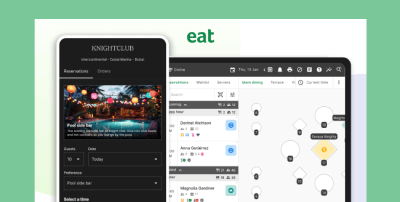
| Integrations | Lightspeed POS, Google Reserve | POS systems (multiple), PBX phone, Google, Instagram, Facebook |
| Multi-location dashboard | Available on higher plans | Centralized dashboard across all locations |
| Customer support | Email, phone | 24/7 support via email and phone, dedicated account managers |
| Regions served | Primarily Canada and North America | 90+ countries, Middle East, Europe, APAC, North America |
Where Libro falls short
Let's be clear: Libro isn't a bad product. For single-location restaurants in Canada, it does the job. But once you start looking under the hood or looking beyond the Canadian border the gaps become harder to ignore.
It's built for Canada first.That's also its limitation.
Libro serves over 3,000 restaurants, and the vast majority are in Canada. That's a strength if you're a single-location bistro in Montréal.It becomes a real problem if you're a multi-location operator thinking about expanding into the US, the Middle East or Europe. The platform just isn't built for international operations the integrations, the support infrastructure and the regional customization aren't there.
If your growth plan stops at the Canadian border this might not matter. If it doesn't it will.
The integration ecosystem is narrower than you'd think.
Libro integrates with Lightspeed POS (K- and L-Series) and Google Reserve along with a handful of payment and marketing tools.For many restaurants that covers the basics.
But "the basics" start to feel limiting when you're trying to connect your phone system, pull spend data from your POS into guest profiles or run WhatsApp campaigns alongside email and SMS.If your tech stack goes beyond a POS and a booking widget, you'll likely need a platform with a broader integration footprint.
Guest CRM and marketing tools lack depth.
Libro offers guest profiles, SMS campaigns and an AI-powered engagement tool they call Sidekick. It's solid for automated confirmations and review collection.
But when it comes to true CRM depth detailed segmentation, spend-based tagging, multi-channel campaign automation and the ability to track a guest's full journey across locations it doesn't match what more mature platforms offer. If you're serious about turning first-time visitors into regulars through data-driven marketing you'll feel the ceiling.
Where Eat App wins
No cover fees. No surprises. A free plan that actually works.
Like Libro, Eat App charges zero cover fees. No per-reservation commissions, no hidden charges that scale with your success.
But here's where we go further: Eat App offers a genuinely usable free plan. Not a 14-day trial, a permanent free tier that includes online reservations, table management and a digital floor plan.It's designed for restaurants that want to test the waters without a sales call or a credit card.
When you're ready to scale up, paid plans start at $49/month and include unlimited bookings, SMS and email confirmations and waitlist management. No surprises on your invoice.
A CRM built for restaurants that care about repeat business.
This is where the Libro vs Eat App comparison gets interesting.
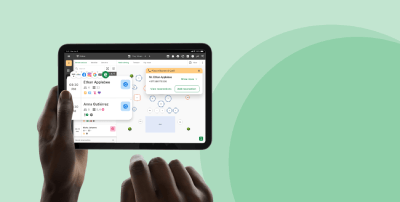
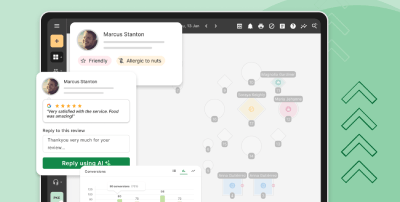
Eat App's guest CRM doesn't just store names and phone numbers. Every guest profile captures visit history, dining preferences, spend data (when connected to your POS), custom tags, notes from your staff and feedback from automated post-dining surveys. It's a living record of each guest relationship.
From there you can segment your database and run targeted campaigns birthday offers to your regulars, a "we miss you" message to guests who haven't visited in 90 days or a VIP invitation to your best spenders. All of this runs through email, SMS or WhatsApp directly from the platform.
One Eat App customer put it well in a G2 review: they highlighted how the centralized CRM made it possible to track guest data and dining habits across multiple venues, use that data for email and WhatsApp marketing, and actually measure the growth those campaigns generated.
That's the kind of CRM depth that moves the needle on repeat visits and it's baked into the platform not bolted on.
Multi-location management that doesn't require a spreadsheet on the side.
If you run more than one restaurant, you already know the pain of toggling between systems. Eat App centralizes everything reservations, guest data, analytics and reporting into a single dashboard.Your operations team gets a bird's-eye view across all locations, while each individual venue retains full control of its own floor plan, shifts and settings.
Libro offers multi-location support on its higher-tier plans, but operators who've compared the two tend to find Eat App's centralized approach more scalable, especially once you're managing three, five or ten locations.
Global reach for operators who think beyond one market.
Eat App is active in over 90 countries. It's the reservation system of choice for major hospitality brands like The Ritz Carlton Group and Fairmont Hotels, and it's used daily by restaurants across the Middle East, Europe, Asia Pacific and North America.
That's not just a vanity metric. It means the platform is built to handle different languages, currencies, time zones and regional booking behaviors. If you're a hotel group, a franchise or an independent operator with plans to grow internationally, Eat App already works where you're going.
Libro is expanding beyond Canada, but today it remains primarily a North American product. For restaurants with global ambitions, that's a meaningful distinction.
What restaurants say after making the switch
Segan C, a General Manager who has used Eat App for over four years, shared on Capterra that the team continuously improves by listening to what service providers actually need. Their hands-on approach and willingness to evolve, he said is what sets them above the rest.
Another operator reviewed Eat App on G2 after comparing it against other vendors and found it diverse in its features and competitively priced. They specifically called out the centralized CRM, measurable booking growth and a proactive support team that engages directly through conference calls not just ticket queues.
These aren't restaurants that chose Eat App because it was cheapest. They chose it because the combination of transparent pricing, deep CRM and real human support delivered better results than what they were using before.
Verdict: Libro vs Eat App
Libro is a solid commission-free reservation system for Canadian restaurants. If you're a single venue, fully invested in the Lightspeed ecosystem & don't need advanced CRM or international capabilities, it'll serve you well.
But if any of the following sound like you, Eat App is worth a serious look:
- You want a free plan to start with not just a trial.
- You need deeper guest CRM with segmentation, spend tracking, and automated campaigns.
- You run (or plan to run) multiple locations, especially across different regions.
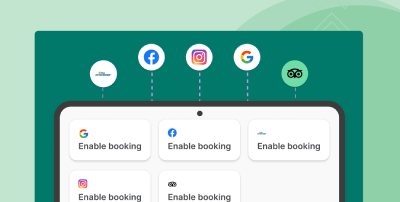
- You want broader integrations with POS, phone systems and multi-channel booking.
- You need a platform that works in North America and beyond.
Restaurant booking software in Canada doesn't have to mean choosing between commission-free pricing and world-class features. With Eat App, you get both.
Start Free No Cover Fees, Ever
Ready to see how Eat App compares to Libro for your specific restaurant? Start with our free plan no credit card, no cover fees, no commitment. Or book a personalized demo and we'll walk you through exactly how Eat App can support your operation.
Get started with Eat App's free trial

.png?width=670&height=440&name=Untitled%20design%20(16).png)


.webp?width=144&height=72&name=Eat%20App%20Logo%20(3).webp "Eat App")