


.svg)
.svg)















.svg)

.svg)


.png?width=200&name=image%20(16).png)
.png?width=200&name=image%20(15).png)
-1.png?width=1812&height=1072&name=TripAdvisor%20%26%20More%20Bookings%20(1)-1.png)
-2.png?width=1812&height=1072&name=Google%20Bookings%20(1)-2.png)
%20(1)-1.webp?width=200&name=Eat%20(57)%20(1)-1.webp)
.png?width=200&name=image%20(14).png)
-1.png?width=200&name=TripAdvisor%20%26%20More%20Bookings%20(1)-1.png)
-2.png?width=200&name=Google%20Bookings%20(1)-2.png)
-1.png?width=200&name=Instagram%20Bookings%20(1)-1.png)
-1-png.webp?width=200&name=Facebook%20Integration%20Rectangle%20(1)-1-png.webp)


.webp?width=200&name=download%20(1).webp)
%20(1)-2.webp?width=200&name=Eat%20(34)%20(1)-2.webp)
%20(1)-2.webp?width=200&name=Eat%20(18)%20(1)-2.webp)







If you're running a restaurant or hotel F&B operation in Switzerland, Germany, or Austria, you've almost certainly come across Aleno. The Zurich-based "digital assistant for restaurants and hotels" has built a solid reputation in the DACH region, particularly among upscale restaurants and hotel groups that need tight PMS integration and sophisticated table planning.
But if you're here searching for an aleno alternative, something about the fit isn't quite right. Maybe you operate outside the DACH region and need a platform with genuine global infrastructure. Maybe you need deeper marketing automation WhatsApp campaigns, loyalty programmes, SMS blasts that go beyond what Aleno's Mailchimp integration can deliver. Or maybe you want transparent, published pricing with a free plan to test before you commit, rather than a custom quote you can only get after a demo call.
Whatever brought you here, this guide provides a detailed, honest comparison between Aleno and Eat App covering pricing, features, CRM, integrations and global reach so you can choose the right restaurant reservation software for your operation.
What Aleno does well
Aleno deserves credit.It's a well-built platform designed by people who understand daily restaurant operations and that shows in the product.
The platform combines reservation management, a graphical table plan (called "seatIn"), guest data management ("relatIn"), and analytics ("reportIn") into what Aleno calls a "digital assistant." It's commission-free, web-based, and supports over 30 integrations with POS systems (Lightspeed, Hypersoft, GMS, TCPOS), hotel PMS platforms (MEWS, Protel, Fidelio, Oracle Opera, Apaleo), and tools like Mailchimp, Google Reserve and Stripe.
For hotel restaurants specifically, Aleno's PMS integration is a genuine standout. It synchronises guest stay data with restaurant reservations in real time so when a hotel guest's meal plan changes in the PMS, Aleno updates the restaurant reservation automatically. Front-of-house staff can see whether a diner is currently checked in to the hotel, enabling targeted upselling and a more seamless guest journey between rooms and F&B.
Aleno also offers AI-controlled table planning, automated confirmation and reminder emails, no-show fee collection via Aleno Pay, event management with online ticketing and a white-label booking widget that can be customised to match the restaurant's brand identity.The platform supports multiple languages, which matters in multilingual markets like Switzerland.
Hotel Tech Report reviewers consistently praise Aleno for being the "best restaurant reservation management system" they've used particularly for hotel restaurants where PMS integration is essential.
Aleno vs Eat App at a Glance
| Feature | Aleno | Eat App |
| Starting price | Custom pricing (not published; quote required) | $0/mo (permanent free plan) |
| Free plan | No | Yes, reservations, floor plan, table management |
| Free trial | Demo-based | Yes, permanent free tier, no credit card |
| Per-cover fees | None | None |
| Guest CRM | Guest profiles with preferences, visit history, tags, and cross-outlet data sharing | Advanced CRM with segmentation, spend tracking, dietary notes, tags, and campaign tools |
| Marketing automation | Via Mailchimp integration (external) | Built-in email, SMS, and WhatsApp automation |
| Loyalty programme | No native loyalty | Yes — built-in points, vouchers, automated rewards |
| POS integrations | Lightspeed, Hypersoft, GMS, TCPOS, HelloTess | 30+ POS systems including Toast, Square, Lightspeed, Foodics, Oracle, Revel |
| PMS integrations | MEWS, Protel, Fidelio, Oracle Opera, Apaleo | PMS integration available |
| AI features | AI table planning, AI phone assistant (via Assistent.ai) | No-show prediction, smart wait times, AI seating logic |
| Countries served | DACH region primarily (Switzerland, Germany, Austria); expanding in Europe | 90+ countries — Middle East, Europe, APAC, North America |
| Multi-location dashboard | Yes, restaurant groups with shared guest data | Yes, centralised dashboard across all locations and regions |
| Device support | Web-based (any device) | iPad, Android, iOS, web browser |
| Customer support | Customer Success Team (European hours) | 24/7 email and phone, dedicated account managers |
| Parent company | Independent (Zurich-based) | Independent (VC-backed, $16M raised) |
Pricing Comparison: What restaurants actually pay
This is where the Aleno vs Eat App comparison gets immediately practical — and where Eat App's transparency is a clear advantage.
Aleno does not publish pricing on its website. The company uses custom, quote-based pricing that's presented during a free demo consultation. Multiple sources describe it as "transparent fixed pricing, depending on the number of guests," with add-ons available for additional features. However, no specific price tiers are publicly available, making it impossible for operators to compare costs without initiating a sales conversation.
| Cost Element | Aleno (estimated) | Eat App Free | Eat App Starter | Eat App Pro | Eat App Enterprise |
| Monthly subscription | Custom quote (not published) | $0 | ~$99 | ~$389 | ~$499 |
| Annual cost | Unknown | $0 | ~$588 | ~$1,668 | ~$2,868 |
| POS integration | Included (varies) | N/A | Add-on ~$129/mo | Add-on ~$129/mo | Included |
| Per-cover fees | None | None | None | None | None |
| Free trial | No (demo only) | Permanent free plan | 14-day trial | 14-day trial | Demo available |
| Contract | Custom | None | Month-to-month | Month-to-month | Flexible |
| SMS/messaging fees | External provider costs may apply | Included in plan allocations | Included | Included | Included |
For operators who value the ability to evaluate pricing upfront, compare against their budget and start with zero financial commitment, Eat App's model removes friction entirely.You can sign up for the free plan today, configure your floor plan, and start taking reservations without a sales call, a demo or a credit card.
Feature-by-Feature comparison
Both platforms position themselves as all-in-one guest management solutions.The differences emerge in marketing depth, AI capabilities, global infrastructure and pricing accessibility.
Table 3: Feature matrix
| Feature | Aleno | Eat App |
| Online reservations | ✅ | ✅ |
| Table management / floor plan | ✅ (seatIn) | ✅ (real-time interactive) |
| Digital waitlist | ✅ | ✅ |
| Guest CRM profiles | ✅ | ✅ |
| Guest segmentation & tagging | ✅ | ✅ Advanced |
| Cross-outlet guest data sharing | ✅ | ✅ |
| Email marketing campaigns | Via Mailchimp integration | ✅ Built-in |
| SMS marketing campaigns | Via external provider | ✅Built-in |
| WhatsApp messaging | ❌ | ✅ |
| Loyalty programme | ❌ | ✅ Built-in |
| No-show prediction (AI) | ❌ | ✅ |
| Smart wait time estimation (AI) | ❌ | ✅ |
| AI table planning | ✅ | ✅ |
| AI phone assistant | ✅ (via Assistent.ai partner) | ❌ |
| Automated post-dining surveys | ❌ | ✅ |
| Review management | Via re:spondelligent integration | ✅ Built-in |
| Event ticketing | ✅ | ❌ |
| No-show fee collection | ✅ (Aleno Pay) | ✅ (credit card holds, deposits) |
| Pay at table | ❌ | ✅ |
| Multi-location dashboard | ✅ | ✅ |
| 3D floorplan tours | ❌ | ✅ |
| API access | ✅ | ✅ |
| White-label booking widget | ✅ (highly customisable) | ✅ |
| PBX phone system integration | ❌ | ✅ |
| Hotel PMS integration | ✅ (deep — MEWS, Protel, Opera, Apaleo, Fidelio) | ✅ |
| Google Reserve | ✅ | ✅ |
Reservations and Table Management
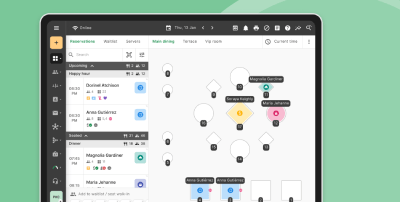
Both platforms deliver strong core reservation capabilities. Aleno's "seatIn" graphical table plan is well-regarded for its flexibility operators can adjust settings by shift, day or even hour, with variable capacity controls and retention time optimisation.The AI-controlled table planning distributes reservations efficiently across the floor.
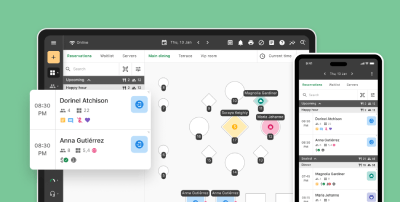
Eat App matches these capabilities with its real-time interactive floor plan and adds AI-driven seating logic that maximises table turns across complex layouts. A G2 reviewer managing multiple venues noted that Eat App's "AI-driven seating logic helps maximise table turns across even complex floor plans, so we fill more seats intelligently." Another praised the system for solving "overbooking and lost reservations" by centralising all bookings digitally.
Aleno's AI phone assistant (via partner Assistent.ai) is a unique differentiator it handles incoming calls, resolves customer requests and places reservations directly into the system 24/7.This is genuinely useful for restaurants that receive heavy phone traffic and want to reduce front-of-house workload.
Edge: Tie with nuances - Aleno's AI phone assistant and granular shift controls are excellent for European fine dining; Eat App's AI seating logic and phone system (PBX) integration offer different but equally valuable operational advantages.
Guest CRM and Data ownership
Both platforms take guest data seriously but they approach it differently.
Aleno builds 360-degree guest profiles that capture preferences, allergies, visit history, and consumption data from connected POS systems. Guest data is shared across all outlets in a restaurant group and the platform supports GDPR compliance with consent management. The "relatIn" module lets staff tag guests, add notes, and use guest intelligence during service. Aleno's branding promise is that restaurants own their data it's not monetised by a third-party marketplace.
Eat App's CRM offers comparable depth plus built-in marketing tools that Aleno lacks natively. Guest profiles include visit history, dietary notes, spend data via POS integration, custom tags, staff notes and automated feedback from post-dining surveys.The key difference: Eat App's CRM feeds directly into its built-in campaign engine, so you can segment guests and trigger email, SMS or WhatsApp campaigns without leaving the platform or connecting a third-party tool.
A G2 reviewer managing a multi-venue F&B group described how Eat App's "layered guest CRM and tagging allow personalised hospitality we can automate birthday messages, identify VIPs and refine promotions for different segments." The same reviewer highlighted the reporting dashboard that lets them "slice data by location, shift, guest spend or marketing channel."
With Aleno, running marketing campaigns requires connecting Mailchimp and exporting tag-based contact lists. It works, but it adds a step and a separate subscription between your guest data and your marketing execution.
Edge: Eat App - comparable CRM depth, but with built-in marketing automation (email, SMS, WhatsApp) that eliminates the need for external tools like Mailchimp.
Marketing automation and Guest engagement
This is the widest gap in the Aleno vs Eat App comparison.
Aleno's marketing capability centres on its Mailchimp integration. Based on guest tags and preferences, Aleno can automatically create recipient lists in Mailchimp for example, a list of "Champagne Lovers" or "Vegetarians" which you can then use to send targeted newsletters. Automated confirmation and reminder emails are built in and the review management integration (via re:spondelligent) helps operators respond to guest feedback.
Eat App includes a full marketing automation suite natively. Email campaigns with built-in templates, SMS campaigns to segmented guest lists, and WhatsApp messaging all managed from one dashboard. Automated workflows handle post-dining surveys, review requests linked to your Google Business profile, birthday greetings, "we miss you" re-engagement sequences and lapsed-guest campaigns. Eat App also includes a built-in loyalty programme with points, vouchers and automated rewards something Aleno doesn't offer.
One Eat App user on G2 called the platform "a game-changer for managing multiple restaurants on autopilot," specifically praising "CRM, automation, and multi-channel bookings" as the features that deliver the most value.Another noted that the centralised CRM was useful for "email campaigns and WhatsApp marketing blasts"something that would require multiple separate tools in the Aleno ecosystem.
Edge: Eat App - Aleno requires Mailchimp for email marketing and has no SMS, WhatsApp or loyalty capabilities. Eat App includes all of these natively.
Integrations and POS / PMS Compatibility
| Integration | Aleno | Eat App |
| Lightspeed POS | ✅ | ✅ |
| Toast POS | ❌ | ✅ |
| Square POS | ❌ | ✅ |
| Foodics POS | ❌ | ✅ |
| Oracle Micros POS | ❌ | ✅ |
| Hypersoft POS | ✅ | ❌ |
| GMS POS | ✅ | ❌ |
| TCPOS | ✅ | ❌ |
| MEWS PMS | ✅ | ❌ |
| Protel PMS | ✅ | ❌ |
| Oracle Opera PMS | ✅ | ❌ |
| Apaleo PMS | ✅ | ❌ |
| Google Reserve | ✅ | ✅ |
| Instagram Reserve | ❌ | ✅ |
| ❌ | ✅ | |
| Mailchimp | ✅ | ❌ (built-in email) |
| Stripe | ✅ | ✅ |
| Phone system (PBX) | ❌ | ✅ |
| iPad | ✅ | ✅ |
| Android | ✅ | ✅ |
| Web browser | ✅ | ✅ |
The integration story is nuanced. Aleno has deeper European PMS integration if you're a hotel running MEWS, Protel or Oracle Opera, Aleno's PMS connectivity is genuinely best-in-class for the DACH market. It also integrates with European-focused POS systems (Hypersoft, GMS, TCPOS) that Eat App doesn't support.
Eat App integrates with 30+ POS systems globally, including the major North American and Middle Eastern platforms (Toast, Square, Foodics, Oracle Micros, Revel, Clover) that Aleno doesn't connect with. Eat App also offers Instagram Reserve, Facebook booking and PBX phone system integration connecting caller ID data directly to guest profiles.
A G2 reviewer running multiple locations praised Eat App's "seamless integrations, unlimited messaging, and advanced automation" as what gives operators "absolute control over a multi-venue operation."
Edge: Aleno for European hotel PMS integration; Eat App for broader global POS support, social media booking channels and phone system connectivity.
Who should choose Aleno
Aleno is the right choice if your restaurant matches this profile:
You're a hotel restaurant or hotel group in the DACH region (Switzerland, Germany, Austria) and need deep PMS integration with MEWS, Protel, Opera or Apaleo. Your guests frequently cross between hotel stays and restaurant visits and real-time data synchronisation between PMS and reservation system is critical.You're running fine dining or upscale concepts in multilingual European markets and want a platform built by restaurateurs who understand European service culture. You value AI-powered phone handling and want to reduce front-of-house call volume with an automated assistant.Your marketing needs are covered by Mailchimp and you don't need built-in SMS, WhatsApp or loyalty tools. Your operation is entirely within Europe and doesn't require global coverage.
Who Should Choose Eat App
Eat App is the smarter Aleno alternative if any of the following apply:
You want a free plan to start with real reservations, table management, and a floor plan. No credit card, no demo call, no custom quote required. You need built-in marketing automation email, SMS and WhatsApp campaigns with segmentation, loyalty programmes and automated guest engagement without connecting third-party tools.You operate outside the DACH region or across multiple international markets. Eat App serves 90+ countries with particular strength in the Middle East, Europe, Southeast Asia and North America. You run a multi-location restaurant group and need a centralised dashboard that spans regions, with transparent pricing you can evaluate before talking to sales. You want broader POS integration with systems like Toast, Square, Foodics or Oracle Micros that Aleno doesn't connect with. You value transparent pricing with month-to-month flexibility and no annual contracts.
What Real Users Say: Review Summary
Aleno: Loved for Hotel Integration, Limited by Marketing Tools
Hotel operators consistently praise Aleno for its PMS integration depth, customisable booking widget, and shared guest data across outlets. One Hotel Tech Report reviewer called it the "best restaurant reservation management system" for hotels, highlighting PMS interfaces and 360-degree guest profiles. Another praised the platform's flexibility in settings that can be changed "for different outlets, shifts, days, yes even hours."
Criticisms are harder to find publicly (Aleno has limited review presence on G2 and Capterra), but the platform's marketing capabilities are its most common limitation — operators needing advanced campaign automation, WhatsApp messaging, or loyalty tools must rely on external integrations.
Eat App: Loved for CRM and Automation, Expanding in Europe
Operators consistently praise Eat App's CRM depth, marketing automation, proactive support team, and ease of onboarding. Multi-venue operators highlight the centralised dashboard, cross-location guest tracking and WhatsApp marketing capabilities.After comparing Eat App with other vendors including SevenRooms, one G2 reviewer found Eat App "diverse in its features and competitively priced."
The most common criticisms include limited brand awareness in European markets (though this is rapidly changing) and occasional POS integration challenges during initial setup.
Beyond the DACH eegion: Why global operators choose Eat App
Aleno's strength is concentrated in Switzerland, Germany and Austria with some presence in other European markets.The platform's POS and PMS integrations, support infrastructure and product DNA are built for the DACH hospitality ecosystem.
Eat App operates in 90+ countries with established infrastructure across the Middle East, Europe, Southeast Asia, APAC and North America. It's trusted by global hospitality brands including The Ritz-Carlton Group, Fairmont Hotels, Four Seasons and Emaar Hospitality Group (deployed across 50+ restaurants).
For a hotel group running F&B outlets across Dubai, Zurich and Singapore, Eat App provides a single centralised dashboard across all locations. With Aleno, your Swiss properties would be well served, but your Middle Eastern and Asian outlets would need an entirely separate system fragmenting guest data and doubling operational complexity.
Making the switch: How to migrate from Aleno to Eat App
Step 1: Export your data. Use Aleno's guest data export capabilities to extract your guest profiles, visit history, tags and preferences.
Step 2: Set up Eat App. Sign up for the free plan and configure your floor plan, shifts, and booking widget. Most restaurants are live within hours.
Step 3: Import your guest data. Eat App's support team assists with data import during onboarding, ensuring profiles carry over cleanly.
Step 4: Activate marketing. Set up automated campaigns welcome sequences, post-dining surveys, birthday offers, loyalty programme to maintain guest communication without interruption.
Step 5: Connect your channels. Link Google Reserve, Instagram, Facebook, and your website booking widget to start capturing reservations across all channels.
How Eat App compares to other reservation platforms
Still weighing your options? These comparisons cover other major platforms:
- Eat App vs OpenTable - Commission-based vs commission-free reservations.
- Eat App vs SevenRooms - Enterprise CRM vs all-in-one platform for growing operators.
- Eat App vs Resy - Discovery platform vs standalone guest management.
- Eat App vs Resos - Feature and pricing comparison for independent restaurants.
- 10 Best Restaurant CRM Systems Compared - The complete CRM market overview.
The Bottom line: Aleno vs Eat App
Aleno is an excellent restaurant reservation system for the DACH market. For hotel restaurants in Switzerland, Germany and Austria that need deep PMS integration and sophisticated table planning, it's a strong choice particularly if your marketing needs are simple enough to handle through Mailchimp.
But for the vast majority of restaurants independents, growing chains, hotel F&B groups operating internationally and operators who need built-in marketing automation without external tools Eat App delivers equal or greater functionality at transparent pricing that starts at $0/month.
The core positioning difference: Aleno is a digital assistant built for European fine dining and hotel restaurants.Eat App is a global guest management platform built for every restaurant that wants to own its guest relationships, automate its marketing and grow without regional limitations.
Start Free - No Cover Fees, Ever
Ready to see how Eat App compares to Aleno for your restaurant? Start with our free plan no credit card, no cover fees, no annual contract.
Get started with Eat App's free trial

.png?width=670&height=440&name=Untitled%20design%20(22).png)


.webp?width=144&height=72&name=Eat%20App%20Logo%20(3).webp "Eat App")