


.svg)
.svg)

















.svg)

.svg)


-2-1.webp?width=200&name=image5%20(6)-2-1.webp)
%20(1)-1.webp?width=200&name=Eat%20(57)%20(1)-1.webp)
-1.png?width=1812&height=1072&name=TripAdvisor%20%26%20More%20Bookings%20(1)-1.png)
-2.png?width=1812&height=1072&name=Google%20Bookings%20(1)-2.png)
%20(1)-1.webp?width=200&name=Eat%20(62)%20(1)-1.webp)

-1.png?width=200&name=TripAdvisor%20%26%20More%20Bookings%20(1)-1.png)
-2.png?width=200&name=Google%20Bookings%20(1)-2.png)
-1.png?width=200&name=Instagram%20Bookings%20(1)-1.png)
-1-png.webp?width=200&name=Facebook%20Integration%20Rectangle%20(1)-1-png.webp)





.webp?width=200&name=download%20(1).webp)
%20(1)-2.webp?width=200&name=Eat%20(34)%20(1)-2.webp)
%20(1)-2.webp?width=200&name=Eat%20(18)%20(1)-2.webp)








Most restaurant surveys are a waste of everyone’s time. Fourteen questions long, sent three days after the visit, asking things like “Was our staff courteous?” Nobody finishes them. Nobody reads the results. They exist so the owner can feel like they’re doing something.
That’s not what we’re talking about here.
A good restaurant survey is short, timed right, and asks questions you’ll actually act on. Done that way, it’s one of the cheapest and most useful tools in your restaurant. It catches problems before they become one-star online reviews. It tells you what’s actually driving people back — not what you assume.
This isn’t a list of 55 questions to dump into a form and blast at every guest. It’s a breakdown of what to ask, when and why organized by category so you can build something that fits your restaurant instead of copying a generic template.
The actual reason surveys are worth your time
.jpg?width=3999&height=2667&name=pexels-markus-winkler-1430818-18512872%20(1).jpg)
Let’s be honest: most owners say they care about guest feedback but only read it when something goes wrong. A one-star review drops, suddenly everyone’s paying attention. That’s backwards.
The whole point of a survey is that you get the complaint before it goes public. A guest who’s filling out a form is still in a relationship with you. A guest who’s typing a Yelp review has already checked out.
Research from Thanx found that roughly 7 in 10 restaurant customers don’t come back after a first visit. Seven out of ten. If even a fraction of those guests had a fixable issue slow service speed, a cold dish, a wrong order and you never heard about it, that’s revenue you lost for no reason.
Surveys fix that.Not perfectly, not every time. But consistently.
A well-built restaurant customer survey delivers:
- Honest feedback the kind guests won’t say to your server’s face but will type into a form at home
- A private channel for negative feedback, which keeps negative reviews off public platforms
- Actionable data you can track over time, instead of just reacting to individual incidents
- Valuable insights into what’s bringing people back for a next visit, so you can do more of it
- A way to measure customer satisfaction consistently, not just when things go wrong
According to a Deloitte study on restaurant customer experience, a positive dining experience makes 60% of guests more likely to become regulars. Surveys are how you find out whether guests are having that experience and where it’s falling short.
Before you pick a single question
There’s one mistake worth calling out before we get into the list: writing a survey around what’s easy to ask rather than what you actually need to know.
If you’re trying to understand why your weekend lunch service gets worse ratings than dinner, build a survey around that. If you launched a new delivery service and want to know how it’s landing with restaurant customers, write a short separate survey just for that. A generic, covers-everything restaurant feedback form is almost never the right answer.
Think of each survey as a specific conversation, not a report card.
On question formats you’ve got four options:
- Rating scales (1–5 or 1–10) - fast, comparable over time, easy to chart. Best for food quality, service quality and overall dining experience scores
- Yes/No - good for factual stuff like “Did your food arrive on time?” or “Were special requests accommodated?”
- Multiple choice - useful when you want structure without making guests write; good for customer preferences and visit frequency
- Open-ended - the richest data, but limit to one or two or completion rates tank
Five to ten questions is the ceiling for a single survey. Past that, survey fatigue sets in and your data quality drops because only your most motivated guests finish it.Three minutes or less. That’s the target.
55+ questions to ask in a restaurant survey
Seven categories.Pick what’s relevant to what you’re trying to learn. You won’t use all of these in one survey that’s the point.
General customer satisfaction questions
Start here if you’re not sure where to start. These questions give you the baseline how guests felt overall, whether they’re likely to return, whether they’d recommend you.Track these consistently and you’ll start to see whether you’re moving in the right direction.
- How would you rate your overall dining experience today? (1–10)
- Is this your first time visiting us?
- How often do you typically dine at [Restaurant name]?
- What was the highlight of your visit?
- What was the one thing you’d most like us to improve?
- How did you hear about [Restaurant name]?
- Would you recommend us to a friend or family member?
- How likely are you to visit us again? (1–10)
That last question likelihood to return is worth tracking over time. It’s one of the cleaner proxies for how a restaurant is actually doing. If it’s trending down over three months, something structural is wrong.
Food quality questions
Food is the reason people came. These food restaurant survey questions get into more than just “was it good” they surface issues with menu variety, portion sizes, food presentation and whether what arrived matched what was ordered. That last one matters more than people think. Wrong orders are a quiet killer for guest satisfaction.
- How did you enjoy the overall food quality?
- What did you order?
- Were you served what you ordered?
- Did your food arrive in a timely manner?
- How would you rate the food presentation?
- Were portion sizes what you expected?
- What do you think of our current menu variety?
- Did you try any of our specials? If so, how were they?
- Were we able to accommodate any dietary restrictions or special requests?
- How would you rate the quality of the beverages you ordered?
- How satisfied are you with our drink selection?
- Are there any menu items you’d like to see added?
One open-ended food quality question “What would you change about our menu?” often surfaces things you’d never think to ask about directly. Worth including occasionally.
Restaurant service survey questions and guest feedback
Service quality is the thing that’s hardest to see from the inside. You can taste the food. You can walk the floor. But whether your servers are actually attentive or just appearing to be is almost impossible to know without asking guests directly. Staff friendliness, service speed and attentiveness consistently show up as top drivers of repeat visits in survey data.
- How would you rate our service overall?
- How long did you wait to be seated?
- Was our staff friendly and welcoming?
- Was your server able to answer your questions about the menu?
- Did your server mention any specials or recommendations?
- How attentive was your server throughout the meal?
- Were courses spaced out at a comfortable pace?
- Was the table cleared between courses?
- Did your server check in on you regularly without being intrusive?
- Did your server confirm your satisfaction after your meal arrived?
- What’s one thing our team could do better?
The “check in without being intrusive” question is underrated. Guests hate being hovered over almost as much as they hate being ignored. Feedback on that question alone can reshape how you train servers.
Questions about the reservation process
The guest experience starts before anyone walks through the door. If your booking flow is clunky a confusing online reservation system, missing confirmation emails, reservations not honored on time guests arrive already irritated. These questions tell you where that friction is.
- Did you make a reservation before visiting?
- How did you make your reservation (online, phone, app)?
- How easy was the reservation process?
- Did you receive a booking confirmation?
- Did you receive a reminder before your visit?
- Was your reservation honored on time?
Short category, but useful data. If guests consistently say they didn’t receive a confirmation, that’s a tech fix. If reservations aren’t being honored on time on weekends, that’s a staffing conversation.
Questions about ambiance and the dining experience
Ambiance is vague until it isn’t. Guests struggle to articulate the restaurant’s atmosphere in a public review, which is why you almost never get useful detailed feedback on it from Google or Yelp. Surveys change that. Noise levels, lighting, how welcoming the space felt on arrival — this is the kind of relevant feedback that only shows up when you ask for it directly.
- Did the restaurant feel welcoming when you arrived?
- How would you describe the overall atmosphere?
- Were noise levels comfortable?
- How would you rate the lighting?
- Was the interior space organized and comfortable?
- How clean did the restaurant feel overall?
Noise levels is the one that surprises owners most. It shows up far more often than expected as a reason guests didn’t fully enjoy their visit. Worth tracking separately if you’re in a lively space.
Questions about cleanliness and facilities
Non-negotiable stuff. If your restrooms are getting flagged repeatedly in survey responses, that’s not a subjective preference it’s a problem that needs fixing today, not next quarter.
- Did our restaurant meet your expectations for cleanliness?
- Were the restrooms clean and well-stocked?
- Was the space accessible and able to accommodate your needs?
Collecting valuable feedback from takeout and delivery: online surveys for off-premises guests
Delivery is its own world. The failure points are completely different from dine-in wrong items, cold food, poor packaging, no status updates. And the expectations of a guest ordering from their couch are different from one coming in for dinner. Treat this feedback as separate from your dine-in data. Mixing it together hides what’s actually going on in each channel.
- Did you place a takeout or delivery order?
- How did you place your order?
- Was the online ordering system easy to use?
- How long did the ordering process take?
- How long did you wait for your meal to be prepared?
- If delivered: how long did delivery take?
- Did you receive exactly what you ordered?
- Were you kept updated on your order’s status in a timely manner?
- Was cutlery or packaging included as expected?
- How satisfied are you with the takeout menu options?
- How could we improve our delivery experience?
How to run customer surveys that actually get completed: timing, length and survey data worth keeping
.jpg?width=6720&height=4480&name=pexels-rdne-9034980%20(1).jpg)
The questions are one part of this. The other part is everything around the survey when you send it, how long it is, who gets it, how it’s framed. Most feedback surveys fail on those things, not on the questions themselves.
Send it fast
Within 12 to 24 hours of the visit. That’s the window for timely feedback. Past 24 hours, recall accuracy drops and so does response rate. For delivery, send it the moment the order is marked delivered. Automated guest surveys connected to your reservation system handle this timing without any manual effort that’s one of the main reasons automation is worth it for digital surveys.
And don’t send survey requests during the meal. Asking a guest to rate their experience while they’re still eating is just awkward.
Keep it short and focused
Five to ten questions, not twelve, not fifteen. Past that, completion rates fall off. If you’re trying to cover too much ground in one survey, that’s a sign you’re trying to solve too many problems at once. Split into targeted surveys by visit type instead.
One or two open-ended questions, max. They give you the richest insights, but they also cause the most drop-off. Put them at the end so guests who bail have at least answered your quantitative questions.
Use the guest’s name and order details
“Hi Sarah, how was your truffle pasta tonight?” is a completely different message than “Please rate your recent dining experience.” One feels like a follow-up from a place that remembers you. The other is a form letter. A restaurant CRM that connects reservation data to your survey sends is how you make this feel personal at scale without anyone on your team writing anything manually.
Pick the right channel for each guest
Email surveys work well for guests who booked ahead or ordered online — you’ve got their contact info and they’re used to hearing from you that way. QR codes on receipts or table cards are better for walk-ins. Social media polls have their place for broad questions, but the data quality is lower. For anything you want to benchmark performance with over time, email or QR-based digital surveys are more reliable.
Tell guests what changed because of their feedback
This one’s underused. When guests see that their survey responses actually changed something the music’s quieter now, there are new gluten-free options, the reservation process is cleaner they respond to the next survey. Continuous improvement has to be visible, not just internal. It also builds the kind of customer loyalty that comes from guests feeling heard rather than just rewarded.
What to do with what you collect: turning survey responses into decisions
.jpg?width=4928&height=3264&name=pexels-goumbik-669621%20(1).jpg)
This is where most restaurants drop the ball. The survey goes out, the responses come in, nobody looks at them. That’s not a feedback system — it’s a checkbox.
The first thing to look for isn’t the worst review or the best one. It’s patterns. One complaint about noise is an opinion. Five in two weeks is a signal you need to act on. Quantitative scores give you the signal; open-ended survey responses tell you what’s driving it.
This is also how restaurant reputation management works at the operational level you catch the themes in your survey data before they show up in public reviews.
Prioritization matters. Health and accessibility issues go to the top of the list immediately. Recurring service quality complaints from multiple guests come next. Subjective customer preferences one guest who wanted the lights dimmer can wait until you have a pattern.
Share the feedback with your team, but do it as coaching, not blame. If survey data shows your restaurant customer service scores consistently drop on weekends, that’s a staffing and training conversation. If a specific server keeps coming up by name as a reason guests were extremely satisfied, call that out in a team meeting. People need to hear both.
Track scores over time. Month-over-month. Quarter-over-quarter. A one-off dip in customer satisfaction tells you something happened. A steady decline tells you something structural is wrong. And tracking is how you know which changes to your restaurant operations actually moved the needle and which didn’t.
One more thing: follow up on negative feedback directly when you can. A guest who rated you 3 out of 10 and left a comment about cold food expects to be ignored. Reaching out with a genuine response not a discount coupon, just an acknowledgement flips that customer’s experience more often than you’d think. That’s the difference between collecting feedback and actually using it.
On doing this without it becoming another thing you have to manage
Paper feedback cards are better than nothing, but they’re slow and hard to analyse at scale. Email surveys you send manually will get deprioritised the moment you’re slammed on a Friday night. The only version of this that sticks long-term is automated restaurant feedback surveys connected to your reservation system.
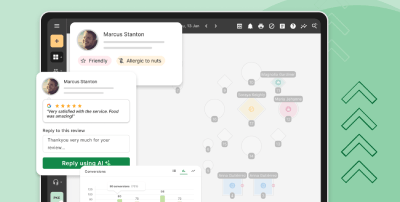
Eat App’s feedback software integrates directly with its table management and reservation system. Surveys go out within 12 hours of a completed reservation, automatically. Responses feed into guest profiles in the restaurant CRM. You wake up to a daily digest of actionable insights instead of manually chasing data through a spreadsheet.
For restaurants with multiple locations, this matters even more. Digital surveys at scale are the only practical way to benchmark performance across sites, identify trends by location and see whether improvements at one site are worth rolling out across others.
Tie it to a restaurant loyalty program and the same guest data that surfaces service issues can also trigger personalised win-back messages for guests who had a bad experience turning a problem into a repeat visit instead of a lost customer.
Wrapping up
None of this is complicated. A short, targeted restaurant feedback survey sent at the right time, to the right guest, and actually acted on is one of the better investments you can make in your restaurant business. The questions in this guide give you more than enough to cover every part of the dining experience from the reservation process and food quality through to delivery and ambiance.
The restaurants that do this well aren’t doing anything fancy. They’re just consistent about asking, listening, and making changes based on what they hear. That’s what turns survey responses into stronger guest relationships over time.
Ready to collect better guest feedback?
Eat App’s automated guest survey software sends post-dining surveys automatically within 12 hours of every reservation. No manual follow-up. No third-party tools. Just honest restaurant guest feedback delivered straight to your dashboard.
Book a demo to see how Eat App helps you gather feedback, identify trends, and build the kind of customer loyalty that keeps tables full.
Get started with Eat App's free

.svg)



%20(1).webp?width=314&height=175&name=Eat%20(7)%20(1).webp)

.webp?width=314&height=175&name=image2%20(5).webp)


.webp?width=144&height=72&name=Eat%20App%20Logo%20(3).webp "Eat App")