


.svg)
.svg)















.svg)

.svg)


-1.png?width=1812&height=1072&name=TripAdvisor%20%26%20More%20Bookings%20(1)-1.png)
-2.png?width=1812&height=1072&name=Google%20Bookings%20(1)-2.png)
-1.png?width=200&name=TripAdvisor%20%26%20More%20Bookings%20(1)-1.png)
-2.png?width=200&name=Google%20Bookings%20(1)-2.png)
-1.png?width=200&name=Instagram%20Bookings%20(1)-1.png)
-1-png.webp?width=200&name=Facebook%20Integration%20Rectangle%20(1)-1-png.webp)

.webp?width=200&name=download%20(1).webp)
%20(1)-2.webp?width=200&name=Eat%20(34)%20(1)-2.webp)
%20(1)-2.webp?width=200&name=Eat%20(18)%20(1)-2.webp)







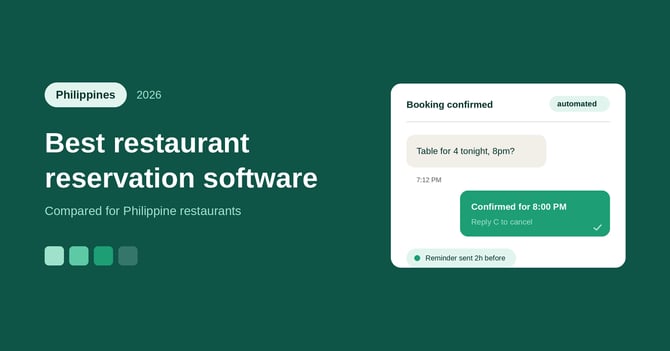
Filipino diners are already booking online eatigo calls itself Manila's number-one reservation platform and Booky Prime covers 2,500+ restaurants nationwide but those are consumer deals apps, not tools for running your floor. The gap in the Philippine market is on the operator side: a system that manages your book, confirms guests on Messenger, Viber or WhatsApp (where Filipino guests actually reply), and takes GCash or card-backed deposits to protect Friday nights in BGC from no-shows.
This guide covers the reservation systems that make sense for restaurants in Metro Manila, Cebu and Davao in 2026 with peso-context pricing, because a US-priced subscription plus per-cover fees rarely pencils out here. (Comparing platforms globally instead? Start with our guide to the best restaurant reservation systems overall.)
Philippine reservation software compared (2026)
| Tool | Price (PH context) | Free plan | WhatsApp / Messenger / SMS | Local support | Best for |
| Eat App | Regional SEA pricing ≈30% below US list; from $0 | Yes,100 covers/mo | WhatsApp confirmations + SMS built in | 24/7 live support, active PH market team | Full front-of-house management for independents, groups & hotel F&B |
| Tableo | From low-cost tiers (~₱1,000s/mo) | Yes | SMS & email | Email/chat (EU hours) | Small restaurants wanting simple, cheap table management |
| TableCheck | Quote-based | No | Email, SMS | Regional (Japan/SEA), hotel-focused | International hotel F&B in Manila |
| eatigo | Free for restaurants (deal-funded model) | Yes | In-app | Yes, Manila team | Filling off-peak seats with discount-driven diners |
| Booky | Partnership/commission model | — | In-app | Yes, PH-based | Discovery & deals exposure, not floor management |
| easyTable | Subscription (EU pricing) | No | SMS | Email (EU hours) | Simple booking widget needs |
| GloriaFood | Free core; paid add-ons | Yes | Global email support | Budget-first cafés wanting a free booking widget | |
| OpenTable | US-style fees; minimal PH network | No | Yes | No local PH presence | Rarely the right fit in PH (see below) |
Pricing checked July 2026. PHP figures are approximate conversions, most vendors bill in USD.
1. Eat App
Eat App is the most complete reservation and guest-management platform actively sold in the Philippine market and Philippine restaurants get something US operators don't: regional pricing roughly 30% below US list rates, billed on flat monthly plans with no per-cover fees. See the [Southeast Asia pricing page]([INSERT Cat 2 pricing URL]) for current peso-equivalent rates.
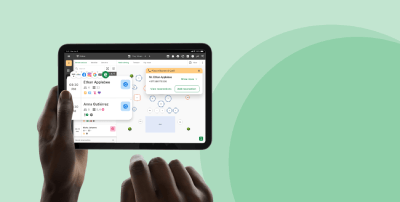
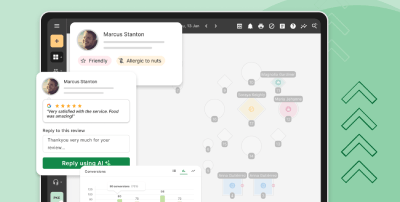
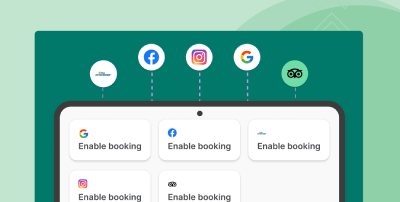
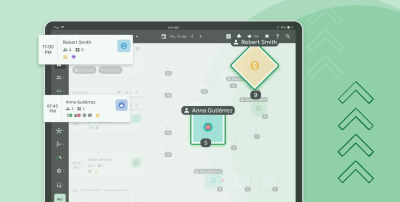
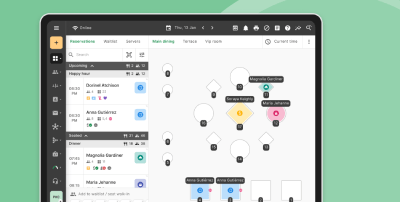
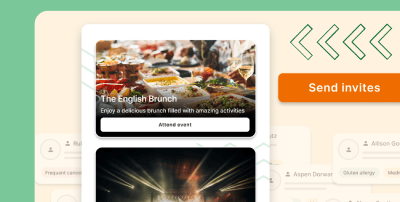
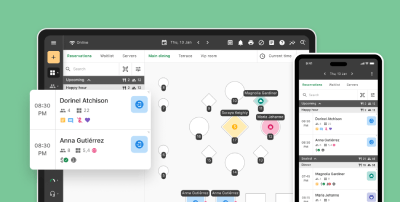
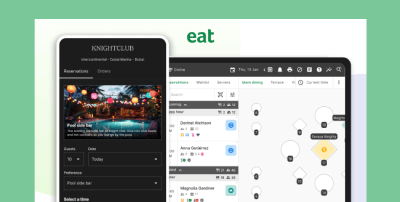
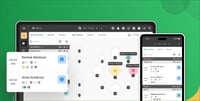
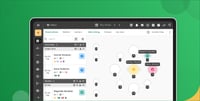
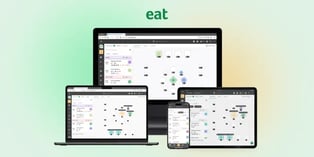
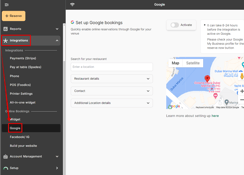
It covers the whole front-of-house: restaurant reservation software with a live floor plan, a guest CRM you own and the feature that matters most locally automated WhatsApp confirmations and reminders alongside SMS, so guests confirm in the messaging apps they already live in rather than ignoring an email. Bookings flow in from Google, Instagram, Facebook, and your own site and card-backed deposits protect big-party bookings on peak nights.
PH pricing (July 2026): the free plan handles up to 100 covers a month at ₱0 a real system, not a trial and paid regional plans start around $69/month (≈₱4,000) for Starter, with unlimited-cover plans above that. (Editor: confirm exact Cat 2 figures against the June 2026 sheet.)
Honest trade-off: Eat App won't flood you with deal-hunting diners the way eatigo can on a Tuesday afternoon. It's built for restaurants that already have demand or are building direct demand through Google and Instagram and want to own the guest relationship instead of renting it.
2. Tableo
Tableo ranks well in Philippine searches for a reason: it's cheap, simple, and has a free entry plan. You get table management, a booking widget, and SMS notifications at prices that suit a single-location restaurant. The limits show at scale support runs on European hours (afternoon-to-midnight PH time), there's no local team, and no WhatsApp-native guest messaging but for a small Makati café that just needs to stop taking bookings in a notebook, it's a reasonable start.
3. TableCheck
Japan-based TableCheck is the quiet player in Manila's five-star hotel dining rooms. It's built for international hotel F&B multilingual booking pages, payments, and brand-consistent guest experiences across properties. Pricing is quote-based and enterprise-oriented, which puts it out of reach (and out of scope) for independent restaurants, but if you run F&B for an international hotel brand in Manila, it belongs on your shortlist.
4. eatigo
eatigo is Manila's biggest consumer reservation brand, with time-based discounts up to 50% across restaurants in Manila, Cebu, and Davao. Understand what it is: a demand engine, not a management system. Restaurants join free and pay in discounts rather than subscriptions — powerful for filling 3pm seats at a hotel buffet, dangerous as a habit if it trains your regulars to only come at 50% off. Many Manila restaurants run eatigo for off-peak alongside a proper reservation system for their book.
5. Booky
Booky is where Metro Manila's younger diners discover restaurants deals, Buy-1-Get-1s, and 2,500+ partner venues via Booky Prime. Like eatigo, it's a marketing channel: it puts you in front of diners but doesn't manage your floor, your waitlist, or your guest data. Treat it as advertising spend, and make sure the bookings it generates land in a system you control.
6. easyTable
Denmark's easyTable shows up in Philippine SERPs with a straightforward pitch: a booking system with SMS confirmations at a flat subscription. It works, but nothing about it is built for the Philippines — no local support hours, no Messenger/Viber/WhatsApp messaging, no GCash-friendly deposit flow. It's what you pick if you found it first, not what you pick after comparing.
7. GloriaFood
GloriaFood's free table-reservation module (paired with its online-ordering system) is genuinely free, which makes it the default for budget-first cafés and QSRs. You get a booking widget and email notifications; you don't get floor management, guest profiles, or local messaging channels. Fine at ₱0 but the first busy Friday usually reveals why management platforms exist.
8. OpenTable
OpenTable in the Philippines is mostly a name diners know from trips abroad: its restaurant network here is thin outside a handful of international hotel venues, so the diner-discovery engine that justifies its US fees $299–$499 monthly plus per-cover charges doesn't deliver in Manila. Unless you're a global brand standardizing on it across markets, Philippine restaurants get more for dramatically less from regional platforms.
How to choose reservation software in the Philippines
Separate discovery apps from management software. eatigo and Booky fill seats; Eat App, Tableo, and TableCheck run your floor. The most common mistake PH restaurants make is treating a deals app as their reservation system then losing the guest data (and repeat-visit margin) to the platform.
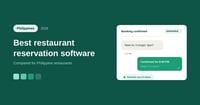
Insist on messaging where Filipinos reply. Email confirmations die unread here. Your system should confirm and remind via WhatsApp, SMS or Messenger/Viber no-show rates drop sharply when the reminder lands in a chat app.
Ask for regional pricing. US list prices assume US margins. Vendors with Southeast Asia pricing tiers (Eat App's run ~30% below US rates) or genuinely free plans deserve the first look; anything with per-cover fees deserves a hard second look at Manila volumes.
Protect peak nights with deposits. No-shows on group bookings are the classic Manila pain. Card-backed holds or deposits for parties of six-plus ideally payable the way your guests pay for everything else turn Friday-night gambling into guaranteed revenue.
Don't forget the walk-in reality. Philippine dining especially mall dining is still heavily walk-in, and weekend queues at popular Ayala or SM mall restaurants are the norm. A pure reservation widget solves half your problem; a system with a digital waitlist and table management handles the Saturday crowd that never booked, which for many PH restaurants is the bigger revenue lever.
Check support hours against yours. A system that breaks at 7pm on a Saturday in BGC needs support that answers at 7pm on a Saturday in BGC not Monday morning in Europe. 24/7 live support or a PH-based team is worth real money.
Frequently Ask Questions (FAQ)
Frequently Ask Questions
A restaurant reservation system is operator-side software that manages your bookings, floor plan, waitlist, and guest database. eatigo and Booky are consumer discovery apps they send you diners (usually via discounts) but don't manage your floor. Most established Manila restaurants use one of each: a deals app for off-peak demand, a management system to run service.
From ₱0 to enterprise quotes. Free plans exist (Eat App at 100 covers/month, Tableo's entry tier, GloriaFood's core module). Paid plans with regional SEA pricing start around $69/month (≈₱4,000). Enterprise hotel platforms like TableCheck are quote-based. Watch for US-style per-cover fees at Manila volumes they rarely make sense.
Eat App's free plan is the most complete at ₱0: 100 covers a month with a live floor plan, guest database, and Google booking integration. GloriaFood is free but widget-only; eatigo is free to join but paid for in discounts.
Directly, rarely most reservation platforms process deposits via card networks. The practical setup Manila restaurants use: card-backed holds or payment links from the reservation system for big parties, with GCash/Maya accepted at the table. Ask any vendor how their deposit flow works for Philippine payment habits before signing.
The good ones do at least one. Eat App includes automated WhatsApp and SMS confirmations and reminders; most international systems (easyTable, GloriaFood, OpenTable) rely on email, which Filipino guests routinely ignore. If no-shows are your problem, chat-app reminders are the single highest-impact feature to shortlist for.
Usually not. OpenTable's value is its diner network, which is thin in the Philippines, while its US-style pricing ($299–$499/month plus per-cover fees) is among the highest in the category. Regional platforms deliver more locally relevant functionality at a fraction of the cost, and Filipino diners are far more likely to find you through Google, Instagram, Booky or eatigo than through OpenTable's app.
Start free with 100 covers a month, ₱0
Eat App's free plan gives Philippine restaurants a real reservation system live floor plan, guest CRM, Google and Instagram bookings, WhatsApp-ready messaging for up to 100 covers a month, with regional SEA pricing when you're ready to grow. Create your free account or book a demo with our team.






.webp?width=144&height=72&name=Eat%20App%20Logo%20(3).webp "Eat App")