


.svg)
.svg)
















.svg)

.svg)


-2-1.webp?width=200&name=image5%20(6)-2-1.webp)
%20(1)-1.webp?width=200&name=Eat%20(57)%20(1)-1.webp)
-1.png?width=1812&height=1072&name=TripAdvisor%20%26%20More%20Bookings%20(1)-1.png)
-2.png?width=1812&height=1072&name=Google%20Bookings%20(1)-2.png)
%20(1)-1.webp?width=200&name=Eat%20(62)%20(1)-1.webp)

-1.png?width=200&name=TripAdvisor%20%26%20More%20Bookings%20(1)-1.png)
-2.png?width=200&name=Google%20Bookings%20(1)-2.png)
-1.png?width=200&name=Instagram%20Bookings%20(1)-1.png)
-1-png.webp?width=200&name=Facebook%20Integration%20Rectangle%20(1)-1-png.webp)



.webp?width=200&name=download%20(1).webp)
%20(1)-2.webp?width=200&name=Eat%20(34)%20(1)-2.webp)
%20(1)-2.webp?width=200&name=Eat%20(18)%20(1)-2.webp)







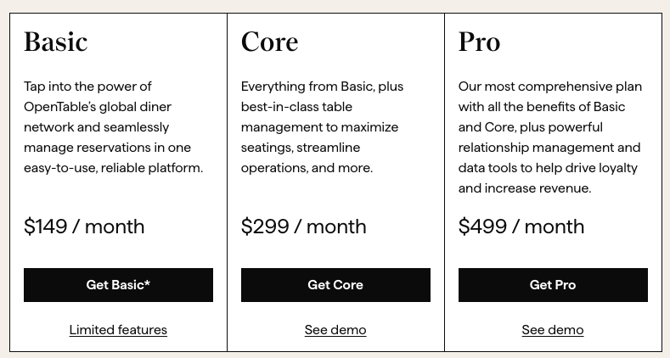
$149, $299, $499. Those are the three numbers OpenTable wants you to focus on.
The number that matters — the one that shows up on your actual invoice at the end of the month — is usually two to six times higher. Depends on how much network traffic you pull. Depends on the corner of the contract you sign into without reading.
Most review-site pricing pages don't walk you through any of that. They quote the sticker, paste a feature list, collect the affiliate fee. I have watched operators sign into OpenTable on the back of those articles, then call me three months later wondering what went sideways. So let's do the math up front this time.
If you only have thirty seconds, here is the short version:
- Basic — $149/month, plus $1.50 per OpenTable network cover, plus $0.25 per website cover (or $49/month flat, which is what you should pick)
- Core — $299/month plus $1 per network cover; website reservations included
- Pro — $499/month plus $1 per network cover; more automation you may or may not use
The rest of this piece is the breakdown the listing sites won't give you. What each plan actually costs, the fees nobody advertises on the published OpenTable plans page, what OpenTable changed in January 2026 that has barely been written about, what a real 100-cover restaurant pays, and how OpenTable stacks up against Eat App and a few other restaurant reservation software options that have stopped charging per-cover fees entirely.
OpenTable pricing at a glance (2026)
OpenTable's pricing is really two things bolted together. A flat monthly subscription you see on the marketing page, and a per cover fee you mostly don't until it shows up on your invoice.
The per cover fee is the one that hurts. A restaurant doing 1,500 network covers a month pays $1,500 to $2,250 in cover fees alone, depending on plan. On Core, that is five times the subscription.
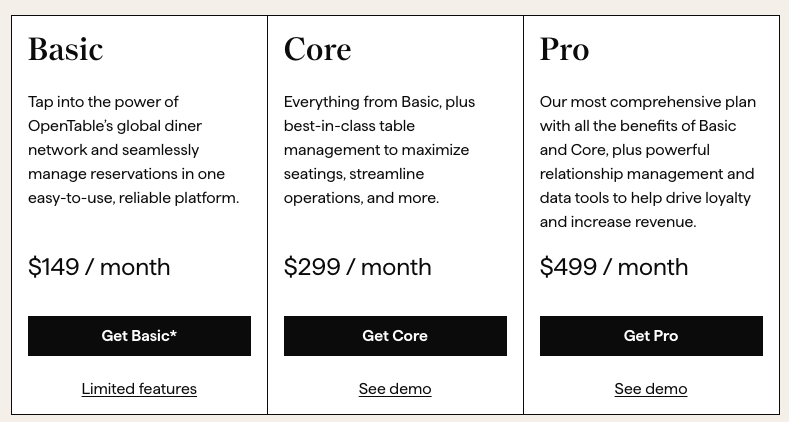
Three plans on offer in 2026:
|
Plan |
Monthly fee |
Network cover fee |
Best for |
|
Basic |
$149 |
$1.50/cover |
Small independents, under ~60 covers per service |
|
Core |
$299 |
$1.00/cover |
Mid-size restaurants doing 80–150 covers per service |
|
Pro |
$499 |
$1.00/cover |
Fine dining, high volume spots, and hospitality groups |
Basic comes with a 30-day free trial. Core and Pro do not. Every plan sits on a 12-month auto-renewing contract — OpenTable's own Basic plan terms require cancellation at least 30 days before renewal. Most operators don't read that clause going in, then spend a whole renewal cycle trying to time their exit.
How does OpenTable work at the fee level?
Two layers. Subscription, plus per-cover on network bookings. Diners coming in from OpenTable's app or opentable website get charged the network rate. Diners who find you directly — your own site, phone, walk-in — are free on Core and Pro, and cost $0.25 each (or $49/month flat) on Basic.
One thing OpenTable genuinely gets right: no shows and cancellations don't trigger cover charges. You only pay for seated diners. Credit where it's due — that policy is fair. The ones coming up are less so.
OpenTable Basic plan — $149/month
Basic is the plan most operators start on. It's also the plan most operators should have left by month four.
The $149 plus a 30-day trial feels like a low-risk test. For a small independent doing 40 to 60 covers a service, it genuinely is. You get your opentable account listed, a booking widget, review management, 100-plus integrations, and enough reservation management to run a quiet shift. Fine.
What the OpenTable app unlocks on Basic
In the box: your opentable profile and listing, basic reservation management, a guest database, review management, Notify Me waitlist leads, credit card holds and deposits, support for Experiences (but not ticketed events), and most of the POS hookups you'd want — Toast, Square, Lightspeed.
Not in the box: floor plan, seat-level POS integration, in-house waitlist, automated email marketing, guest tagging, Premium SMS. If any of those matter to how you actually run service, Basic is the wrong plan and you'll figure that out the expensive way.
The real problem with Basic is the $0.25 per website cover fee. At 200 website covers a month you're already paying $50 — more than the $49 flat option. So pick the flat option and move on. Above 400 website covers a month, Basic starts costing more than Core. Above 1,000, it's a meaningful amount of money to leave on the table for no reason. Most operators run this math about three months in, by which point they're locked into the contract.
My honest take: if you have any plan to grow in the next year, skip Basic. Start on Core. If you're genuinely shopping the small-operator end of the market, compare against TableAgent alternatives and the free-tier platforms before you hand over a credit card.
OpenTable Core plan — $299/month
Core is where OpenTable stops pretending to be a listing service and starts behaving like a reservation system.
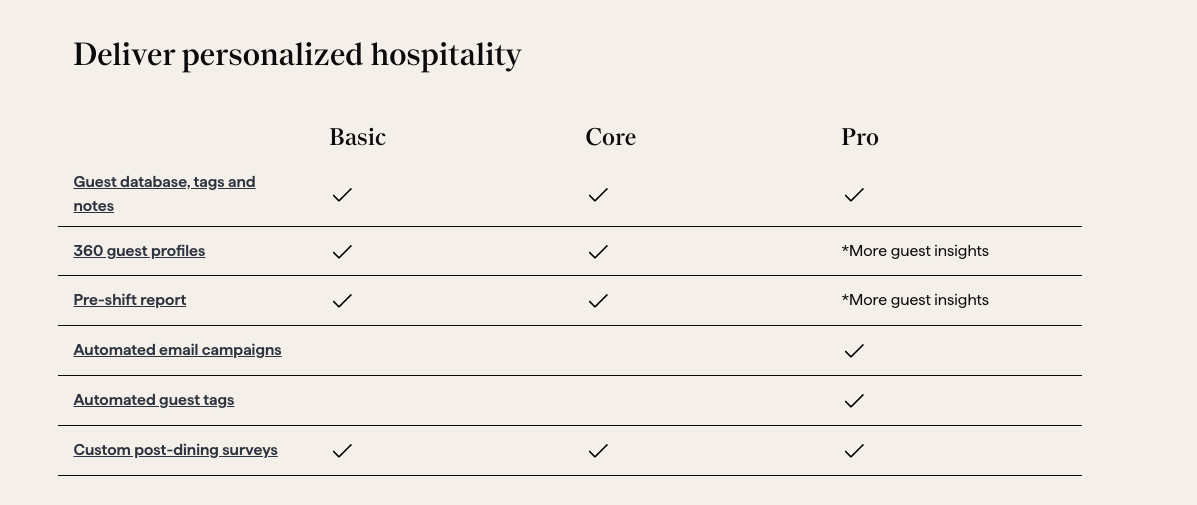
For $150 more than Basic you get customizable floor plans, Smart Assign, in-house and online waitlists, advanced inventory controls, access rules, and a manager's mobile app that lets you work the floor from a phone. Website reservations become free. The per cover fee drops to $1. This is the plan I see most often in 80-to-150-covers-per-service spots — it's the plan the product was really built around.
Core unlocks floor plan and POS integration
POS integration is the real reason to pay the upgrade. Connecting the reservation system to your POS means you can see what a guest spent last time, which tables are pulling what, and how your night is tracking against target — live. Not end-of-shift. Live. That alone changes how a manager runs the floor.
Core also brings 360 guest profiles, direct two-way messaging, and the inventory tools you need to manage waitlists properly across shifts, brunches, private events, and the like.
Premium SMS is a $19/month add-on, which is genuinely annoying. At $299 a month, branded texting should be in the box.
And here is the gotcha — the same one Basic has, just scaled. At 300 network covers a month, Core is $599. At 600 it's $899. At 1,000 you're at $1,299, which is more than four times the sticker. If your bookings lean on opentable discovery rather than your own website, your monthly cost climbs with your success, and you don't really get a say.
Setup also takes longer than you'd think. Floor plan customization is powerful, but you'll spend a few shifts with an onboarding specialist before the system mirrors how your room actually runs. Worth it, but plan for it. If waitlist tooling is a priority on its own, check the best restaurant waitlist management systems and TablesReady alternatives before locking in.
OpenTable Pro plan — $499/month
Pro is the top tier. $499/month, network covers stay at $1, website reservations free, Premium SMS finally included. Everything in Core, plus automation: customizable booking widget, automated email campaigns, automated guest tags, pre-shift reports, post-dining surveys, deeper analytics, and the full table management depth you'd expect at this price point.
Prepaid experiences, guest profiles, and per cover fee math
Pro is the plan for restaurants that live on tasting menus, chef's counters, ticketed wine dinners, and VIP programs. The prepaid experiences stack is solid — though the 2% service fee applies to every one of those transactions. A $150/head tasting menu selling 500 covers a month pays $1,500 in that fee alone, which is worth noting before you price the experience.
Here's the part I'll catch heat for: Pro is oversold. In my experience, roughly one in three restaurants paying for Pro should be on Core. The automation features are nice. They're not $2,400-a-year nice unless you're actually using every one of them. If your hosts are tagging regulars in a notebook and your marketing emails go out from Mailchimp, you are paying for an upgrade you don't touch.
The per cover fee compounds on Pro too. A busy 200-seat fine dining spot doing 1,000 network covers a month pays $1,000 on top of the $499 subscription — $18,000 a year in OpenTable fees, before the 2% on prepaid. At that spend, the honest question is whether a flat-rate platform with comparable CRM would save you $15,000 a year without losing anything critical. Usually, yes. And that's where best restaurant CRM systems comparisons get interesting.
The hidden costs of OpenTable
This is the section that should have been on OpenTable's own pricing page. It isn't.
Cover fees, deposits, and the 2026 2% service fee
In early 2026, OpenTable started applying a 2% service fee to transactions, including no-show penalties, deposits, prepaid experiences. The Philadelphia Inquirer broke it in January. An OpenTable spokesperson told the paper that "online payments are important for restaurants" and framed the fee as part of no-show reduction.
That framing is technically correct and almost completely beside the point. The 2% is a fee on a fee — sitting on top of transactions the restaurant (not OpenTable) set up, often for deposits the diner is already annoyed about paying. Rolling it out mid-contract with limited direct communication was, to put it politely, tone-deaf. I know operators who first heard about it from their own customers.
Then the cover fees themselves. They look small on paper. At 1,500 network covers a month you're paying $1,500 to $2,250 on top of the subscription. Some operators describe this as "the bill scaling with success." That framing is generous. The accurate one is: OpenTable takes a bigger cut the better you do.
No shows, points, and who actually owns your guests
The points program is the most openly anti-operator thing OpenTable does. Diners earn 1,000 reward points for bookings at off-peak times and redeem them at any participating restaurants on the network — yours, your neighbor, your direct competitor across the street. You are funding a loyalty program that actively rewards your diners for going elsewhere next time. Read that again.
If you're also fighting a restaurant no-shows problem on top of that, the answer is deposits and prepaid experiences, not a loyalty scheme pointed at other people's dining rooms.
Data ownership is the deeper issue, and the one that stings once you notice it. Every guest OpenTable captures lives in OpenTable's database. Your access lasts exactly as long as your subscription. The email, the allergy note, the birthday, the party size they usually book — none of it leaves with you if you switch.
Smaller things that add up:
- The contract. One-year auto-renewing with a 30-day cancellation window. This is, genuinely, the single most anti-operator clause in the whole category.
- Premium SMS — $19/month on Core, included on Pro. At $299/month it should be in the box.
- OpenTable Icons and Visa Dining Collection — newer programs that can require holding tables for cardholders or featured diners. Read the fine print before opting in.
- Onboarding — included in the subscription, but custom floor-plan builds stretch the timeline, and nobody warns you.
Stacked together, these shift the total economics by 15 to 30% versus the sticker price. Which matters more than most restaurant owners think, because margins in 2026 aren't what they were. In the 2026 State of the Restaurant Industry report, NRA chief economist Chad Moutray put it bluntly: success in 2026 will "hinge on their ability to get the math right" for operators. Worth quoting back to the next vendor who tries a vague "value" pitch on you.
What does OpenTable really cost a 100-cover restaurant?
Fine. Let's do the real math.
100 covers a night, 25 services a month, 2,500 covers total. Assume 60% come through the OpenTable network (1,500 covers) and 40% from your own website, phone, and walk-ins (1,000 covers). That's a normal split — some spots run heavier network, some heavier direct.
Here's what each plan actually costs that restaurant, per month:
- Basic — $149 + (1,500 × $1.50 network) + (1,000 × $0.25 website) = $2,649/month
- Core — $299 + (1,500 × $1.00 network) + website included = $1,799/month
- Pro — $499 + (1,500 × $1.00 network) + website included = $1,999/month
|
Plan |
Monthly total |
Annual total |
Notes |
|
Basic |
$2,649 |
~$31,800 |
$0.25/cover website fee compounds fast |
|
Core |
$1,799 |
~$21,600 |
Sweet spot for 100-cover operators |
|
Pro |
$1,999 |
~$24,000 |
Worth it if you use the automation |
What most restaurants miss about OpenTable cost
Basic — the cheapest-looking plan — is the most expensive of the three at this volume. This is the single most common mistake I see operators make. They read the $149 sticker, don't run the cover-fee math, and find themselves staring at a $2,600 bill four months in.
Run the numbers at your own volume. Core flips to cheaper than Basic around 400 covers a month, and anyone doing more than 60 a service is past that threshold. Annual totals: Core about $21,600, Pro about $24,000, Basic about $31,800. For a fine dining spot selling $30k/month in prepaid tasting menus, add the 2% service fee and Core goes to roughly $2,400/month — $28,800 a year.
If that's making you wince, that's the point.
Eat App vs OpenTable — head-to-head
OpenTable's network is real, and it's the biggest in the category — 1.7 billion seated diners a year across 60,000-plus venues in 105 countries. If your growth depends on new-diner discovery and you're in a major US market, OpenTable earns its place. Full stop.
For everyone else, the math stops working.
|
Category |
Eat App |
OpenTable |
|
Starting price |
Free |
$149/month |
|
Top tier |
~$223/month flat |
$499/month plus per cover |
|
Per cover fees |
$0 |
$1.00–$1.50 |
|
Free plan |
Yes |
No (30-day trial on Basic) |
|
Contract length |
Month-to-month |
1-year auto-renewing |
|
Guest data ownership |
100% restaurant |
Shared with OpenTable |
|
Built-in CRM |
All tiers |
Pro only |
|
Marketing automation |
WhatsApp, email, SMS |
Email on Pro; SMS $19/mo add-on |
|
POS integrations |
Toast, Square, Lightspeed, 20+ |
100+ |
|
Global coverage |
90+ countries; strongest in MEA, EU, APAC |
105 countries; strongest in US |
Eat App vs Open Table pricing for a 100-cover restaurant
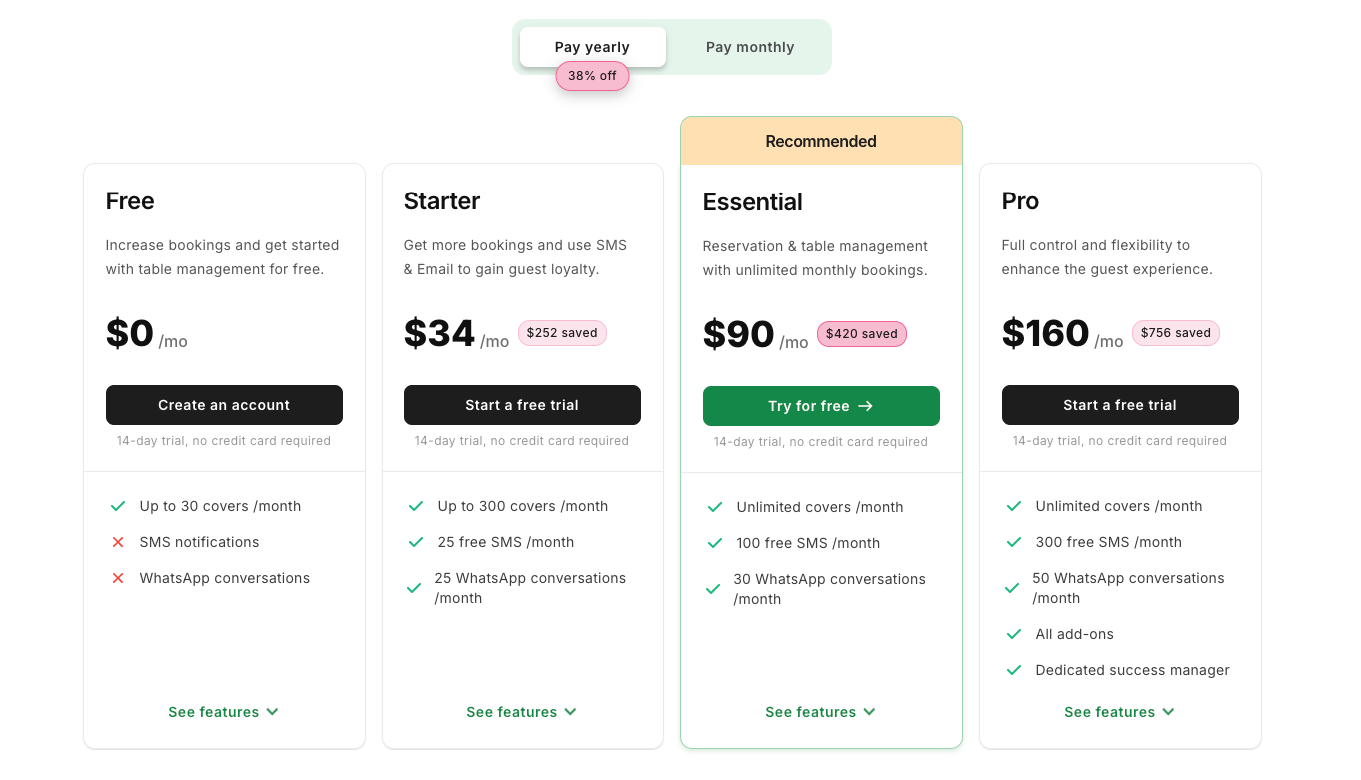
Eat App is flat-rate. Zero per cover fees. Four tiers: Free ($0), Starter ($49), Basic ($119), Pro (about $229). The top plan is $229/month, period.
Run it through the same 100-cover scenario: Eat App Pro is about $229/month. OpenTable Core is about $1,799/month (before the 2% service fee). That's a $1,570/month gap. $18,800 a year. Same booking volume, broadly the same feature set. If you want to see the same exercise applied to another matchup, our TouchBistro alternative breakdown runs the same structure.
The data ownership gap is sharper than the pricing gap, honestly. Every guest record on Eat App — phone, email, preferences, spend history, allergy notes, special occasions, the birthday nobody else remembers — belongs to the restaurant. Searchable, exportable, and usable in built-in WhatsApp, email, and SMS campaigns. On OpenTable, the relationship sits with the platform. When your subscription lapses, so does your access. That matters for marketing. It matters more the longer you've been collecting.
Where OpenTable still wins: discovery, particularly in the US. Eat App serves 5,000-plus restaurants across 90-plus countries, with its strongest positioning in the Middle East, Europe, and Asia-Pacific, and a genuinely smaller US discovery surface. If new diners walking through the door because of the reservation platform itself is your growth lever, OpenTable is the only tool in this comparison that reliably does that job.
Choose Eat App or Open Table if…
- Choose OpenTable if you're a US fine dining destination, new-diner discovery is a real growth channel for you, you can absorb variable per cover charges, and you want OpenTable Icons or Visa Dining exposure.
- Choose Eat App if you want flat and predictable monthly pricing; most of your bookings come through your own site, Google, phone, or social; you want to own the guest data; you operate in the Middle East, Europe, or APAC; or you just need a free tier to start without a sales call.
Honest answer for most independent operators in 2026: OpenTable for the network, Eat App for the economics. And if you're doing mostly direct bookings already, the network case weakens fast.
Other OpenTable alternatives for the restaurant owner shopping around
A few more tools worth a look if neither OpenTable nor Eat App fits your shape. Deeper breakdown in our wider OpenTable alternatives roundup.
- Resy — from about $249/month, owned by American Express. Tock is set to merge into Resy this summer following Amex's February 2026 announcement, which will roughly double Resy's venue footprint. Strong in urban US fine dining. See our OpenTable vs Resy breakdown for the plan-by-plan comparison, and Resy alternatives if neither fits.
- Tock — historically the category leader for prepaid tasting menus and ticketed events. Joining the Resy platform this summer.
- SevenRooms — enterprise pricing, custom quotes. Acquired by DoorDash in June 2025, which is worth knowing if DoorDash being in your reservation stack matters. Fit is best for hospitality groups running multiple venues.
- Hostme — from $109/month, flat pricing, genuinely cheap option for smaller independents.
For a wider comparison of the whole field, our roundup of online restaurant reservation systems is a decent starting point, and ResOS alternatives skews toward the European-flavored end.
The verdict
Four honest questions before you sign anything: how many network covers you realistically expect per month, how much floor-plan and POS integration depth you actually need, whether owning the guest data matters to how you market, and whether you can live with a one-year auto-renewing contract. Those four answers settle most of the decision.
OpenTable earns its keep if the network is genuinely your growth engine; which, for a lot of US fine dining and high volume spots, it still is. Most independent operators in 2026 are not in that bucket. They get more of their bookings from Google, Instagram, their own site, and word of mouth than from OpenTable, and for them the flat-rate alternatives win on math, on contract terms, and on who owns the customer. Everything else is mood lighting.\
Ready for flat-rate pricing with full guest-data ownership? Book a demo with Eat App - see a real side-by-side cost comparison for your restaurant.




.webp?width=144&height=72&name=Eat%20App%20Logo%20(3).webp "Eat App")