


.svg)
.svg)
















.svg)

.svg)


.png?width=200&name=image%20(16).png)
.png?width=200&name=image%20(15).png)
-1.png?width=1812&height=1072&name=TripAdvisor%20%26%20More%20Bookings%20(1)-1.png)
-2.png?width=1812&height=1072&name=Google%20Bookings%20(1)-2.png)
%20(1)-1.webp?width=200&name=Eat%20(57)%20(1)-1.webp)
.png?width=200&name=image%20(14).png)
-1.png?width=200&name=TripAdvisor%20%26%20More%20Bookings%20(1)-1.png)
-2.png?width=200&name=Google%20Bookings%20(1)-2.png)
-1.png?width=200&name=Instagram%20Bookings%20(1)-1.png)
-1-png.webp?width=200&name=Facebook%20Integration%20Rectangle%20(1)-1-png.webp)





.webp?width=200&name=download%20(1).webp)
%20(1)-2.webp?width=200&name=Eat%20(34)%20(1)-2.webp)
%20(1)-2.webp?width=200&name=Eat%20(18)%20(1)-2.webp)







There’s a conversation that happens at basically every hotel. The GM turns to whoever got stuck with marketing duties and asks “where are our bookings actually coming from?” And the answer is some version of “well, we’re doing stuff on social, we ran some Google Ads last month, and the OTAs are… you know… the OTAs.” Nobody can point to what’s working. The online marketing money goes out. Guests trickle in. And no one connects the two.
That’s not a marketing strategy. That’s activity dressed up as progress.
The right hotel marketing tools change this. Not in a “our impressions went up 12%” way — in a “this specific campaign drove $14,000 in direct booking revenue last month” way. They show you where your potential guests actually spend time online, what nudges them toward booking, and which of your digital marketing tools earn their keep versus just running up the tab. This guide covers all of it. Free stuff, paid stuff, the stuff that takes twenty minutes to set up and nobody bothers with.
Why hotel marketing tools keep getting more important for direct bookings
Online travel agencies still control around 55% of hotel bookings worldwide. Sit with that number for a second. Every one of those reservations costs you 15–25% in commission. On a $200/night room, that’s $30–50 per booking vanishing into Expedia’s pocket. Multiply it across a full year and it’s the kind of number that makes hotel owners stare at the ceiling at 2am.

It gets worse. According to SiteMinder’s 2025 Hotel Booking Trends report, hotel websites generated an average of $516 per booking while OTAs pulled just $312. Direct bookers pick better rooms, stay longer, tack on extras. They’re worth more in every measurable way — and you keep all of it.
James Bishop, VP of Ecosystem and Strategic Partnerships at SiteMinder, put it this way: travelers are booking earlier, canceling less, and spreading stays more evenly across the year. That’s stability and opportunity — but only for hotels with the right tools and right data to actually respond when things shift.
So the question isn’t “should we try harder on direct bookings?” Obviously. The question is which marketing tools get you there and which ones are just making you feel busy.
Google Analytics: the hotel marketing tool you have no excuse to skip
If you’re running a hotel and you haven’t set up Google Analytics, you’re guessing. Full stop. You might feel like you know how your website performs. Feelings don’t count.
Google Analytics is a free and powerful tool that shows you what’s actually happening on your site. Where visitors come from — organic search, social media, paid ads, referral links. What pages they linger on. Where they bail. Most critically: where visitors drop off right before completing a booking. That last one is where the money is because it tells you exactly which part of your site is leaking revenue.

Quick story. A hotel in Savannah dug into their Analytics data and found that nearly 70% of mobile visitors left on the room selection page. Eight-second load time on phones. Desktop was fine. They compressed images, restructured the page, and their mobile conversion rate doubled in six weeks. No new ad spend. No redesign. Just reading the right data and doing something about it.
Set up conversion tracking so you can tie direct booking revenue to specific marketing campaigns. Check mobile vs. desktop and be brutally honest about whether your phone experience is actually good. Most aren’t. Google Analytics is a free tool that hands you the answers. Acting on them is on you.
Google Keyword Planner and why most hotels target the wrong keywords
You can have the best hotel website in your city and get absolutely zero organic traffic if you’re optimizing for what you think people search for instead of what they actually type. That’s the gap keyword research closes.
Google Keyword Planner lives inside Google Ads (you don’t need to spend anything to use it). Plug in terms related to your property and it gives you search volumes, competition levels, related phrases. It’s a free tool doing serious work.

Here’s the mistake almost everybody makes. They chase broad terms like “hotel in Miami” and get destroyed by Marriott, Hilton, and every OTA with a seven-figure budget. The real wins are in long-tail phrases. “Pet-friendly boutique hotel near downtown Portland.” “Luxury hotels with rooftop pool near South Beach.” Fewer total searches, absolutely. But the person typing that phrase is basically holding their credit card already.
Build your website content around those longer phrases. Room descriptions, blog posts, FAQ pages — each one can match what a real traveler is asking. And don’t write off search engine optimization because it takes time. That’s actually what makes it good. Unlike paid ads that disappear the second your budget runs out, organic traffic compounds. A page that ranks today keeps pulling visitors next month and the month after and the month after that.
Google Trends and Google Business Profile: absurdly underrated hotel marketing tools
Two tools. Both free. Both punching way above their weight. Most hotels either don’t know they exist or set them up once and never look again.
Google Trends shows when interest in your destination spikes and fades. When people start Googling “beach vacation [your state],” that’s your cue to launch marketing campaigns, adjust rates, push social media posts. It’s seasonal intelligence for free. No consultant required.
Google Business Profile might be the single most underrated marketing tool in the hospitality industry. Bold claim. But think about it — this is where many travelers see your property for the first time, in Maps or local search results, usually before they touch your actual website. Photos, reviews, rates, a direct booking link. It all lives here. And the number of hotels running a half-baked profile with two blurry photos from 2019 is honestly depressing.

Roman Makarenko, CEO of Thunder Marketing Solutions, makes a point worth paying attention to. Travelers now search in full conversational questions — “pet-friendly hotels in Chicago with late checkout” — instead of punching in two-word keyword fragments. Your Business Profile needs to match that. So does your website. The hotels that adapt to this will capture guests their competitors don’t even know are looking.
Keep the profile current. Fresh photos monthly. Respond to every review, good and bad — no exceptions. Update amenities. Maybe thirty minutes a week. It pays back in online visibility that you cannot buy.
Email marketing tools: the highest ROI in hotel marketing and nobody wants to talk about it
Email isn’t sexy. Nobody at a hotel conference gets a standing ovation for their email marketing strategy. But if a hotel could only pick one channel for its marketing strategy, it should be email. I’ll argue with anyone about this.
Hotels typically see around $36 back for every $1 spent on email marketing. That’s 3,600% ROI. Instagram can’t touch that. TikTok can’t touch that. Not even close. When someone gives you their email, you own the relationship. No algorithm deciding who sees your message. No platform skimming a percentage.
Problem is, most hotels absolutely butcher it. Same generic newsletter blasted to the entire list. Seasonal greetings nobody asked for. A photo of the lobby Christmas tree. In July. That kills engagement faster than anything.
What actually works is segmentation. Family that stayed last July? Hit them with a “plan your summer return” email in March. Couple who booked the spa package? Tell them about the new wellness retreat. Someone who browsed rooms but didn’t book? Gentle nudge, limited-time rate. None of this is complicated, but it requires email marketing tools that can actually handle it.
Mailchimp works fine for smaller properties. Revinate and Cendyn are built specifically for hospitality. What matters most: automated workflows. Pre-arrival info, post-stay thank-yous, birthday offers — set them up once and they quietly run in the background driving more direct bookings while your team deals with the guests physically standing at the front desk.
According to Revinate’s 2025 Hospitality Benchmark Report, EMEA hoteliers earned an average of $5.89 for every guest email they captured. But only — and this is the part people skip over — when those emails were targeted. The lesson: capture every email you can. Booking, WiFi login, checkout, wherever. Then send marketing emails that actually matter to the person receiving them. That’s how you build loyal customers, not a bloated contact list gathering dust.
Social media management for hotels (posting pool photos is not a strategy)
Posting a nice pool photo every Tuesday is a hobby. It’s not social media management. It’s not moving the needle. Sorry.
Social media works for hotels when it’s treated as a discovery engine and a trust builder — not a content calendar you fill because someone told you to. Your social media accounts are often the very first place younger travelers look, before your website, before TripAdvisor. What they find shapes their opinion of your property in about three seconds.
Social media management tools like Buffer, Hootsuite, or Later help you schedule social media posts and track what performs. Fine. But the tool matters infinitely less than what you actually post.
The biggest miss? Ignoring user generated content. When a guest tags your hotel in vacation photos, that’s free marketing with built-in credibility that no amount of polished promotional materials can match. A real person grinning on your balcony with a coffee sells rooms. Encourage guests to share with a branded hashtag. Repost their stuff. This kind of visual content outperforms your staged branded photos almost every single time.
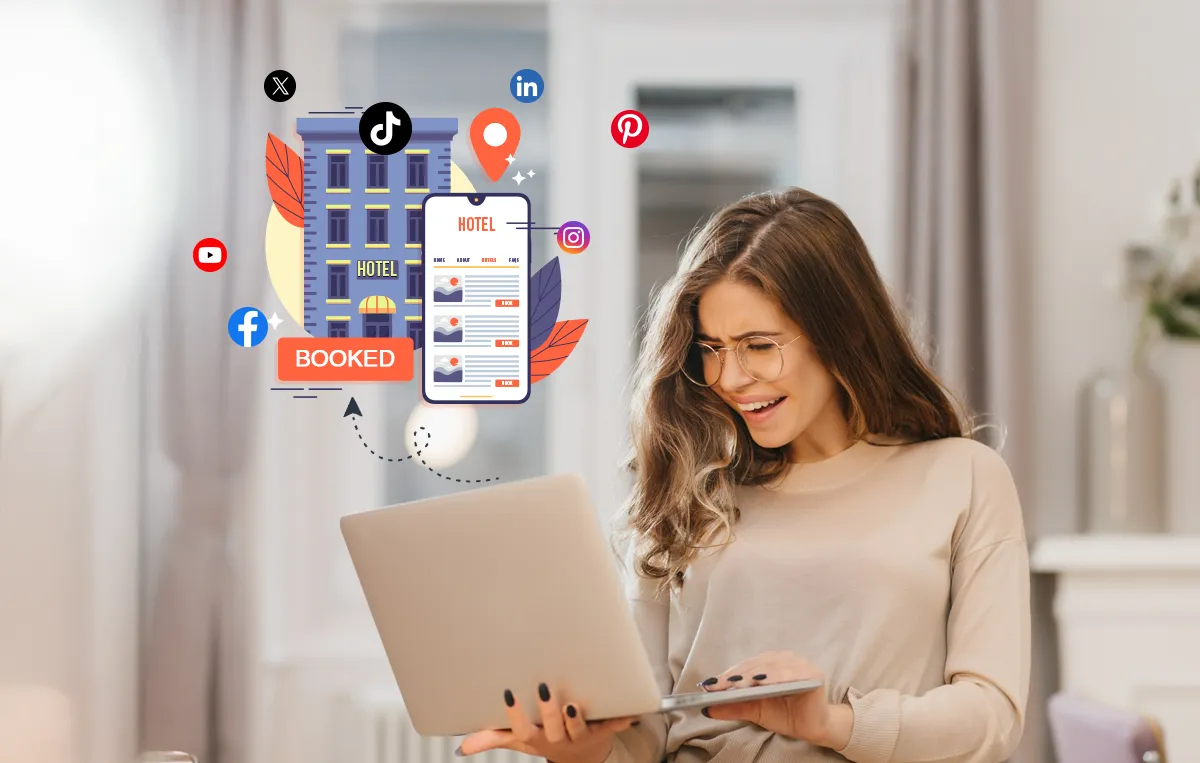
Instagram deserves special mention. Posts and Reels are now indexed by Google, which means your social content can surface in search results and boost visibility well beyond your follower count. Use location tags. Write alt text. Treat every post like it might show up in a Google search, because increasingly, it will.
What about social media ads? Even $10–15/day on Facebook or Instagram targeted advertising can drive real website traffic if your target audience is dialed in. Test different layouts, different images, different hooks. And track which ads produce actual bookings, not clicks. Clicks are vanity. Bookings pay bills.
Content creation tools for the hospitality industry
Hotels do not need an agency for this. A few content creation tools and someone willing to show up consistently will outperform most $5k/month retainers. That’s not a hot take. That’s what actually happens.
Canva covers the visual side — templates for stories, email headers, promotional materials, short videos. The free version handles most of it. The paid version adds brand kits and background removal, which help with brand consistency if you’re managing multiple social media platforms.
For writing: Grammarly catches typos, Google Docs keeps things collaborative. Neither is exciting. Both earn their keep.
Short-form video is dominating right now and it doesn’t need a production crew. A 30-second room walkthrough on your phone. Time-lapse of breakfast service. Bartender making the signature cocktail. This kind of engaging content doesn’t need professional lighting — it needs to feel like a real place run by real people. That’s the whole point.
Why does creating content matter this much? Because travelers research obsessively before they book anything. They want to see what the room actually looks like. Not after a photographer spent two hours staging it — what it actually looks like. Every piece of content is answering a question some potential guest hasn’t thought to ask yet.
SEO tools that grow organic traffic (for the patient ones)
SEO is the broccoli of hotel marketing. Everybody knows they should do more of it. Nobody gets excited. But nothing — and I’ll keep saying this — compounds the way organic traffic does over time.
Google Search Console is free and shows which search queries drive people to your site, how pages rank, and where technical issues hurt your website’s performance. Pair it with Google Analytics and you get the full picture of what your search engine presence actually looks like. Spoiler: it’s usually different from what you assume.

Want to go deeper? Ubersuggest has a limited free version that’s decent for keyword research and competitor analysis. Ahrefs is the gold standard but comes with a price tag. Both show organic traffic data, click through rate, and what competitors rank for that you don’t. That gap is your to-do list.
Local SEO is wildly underestimated by hotels. Is your name, address, and phone number consistent across every directory? Do you have location-specific landing pages — something like “[neighborhood] hotel near [landmark]”? Those pages capture guests searching with real intent, not people idly scrolling at 11pm.
And one thing that too many properties blow off: online reviews directly affect your search engine rankings. A hotel with 400 recent reviews outranks a competitor with 50, even at similar star ratings. Google watches review velocity and whether you respond. So respond to every single one — the five-star love letters and the one-star rants. It tells Google you’re active. It also just… looks better to anyone reading.
CRM systems: the data driven backbone nobody glamorizes
“CRM” sounds enterprise. Like something Hilton needs and your 30-room independent hotel doesn’t. Wrong. Even small properties — especially small properties — benefit enormously from having guest data in one place instead of scattered across spreadsheets, sticky notes, and somebody’s memory.
CRM systems pull together stay history, room preferences, spending patterns, feedback, contact details. They provide insights you can’t get from any single booking channel and play a key role in turning scattered information into marketing efforts that actually convert. Without one, you’re guessing.
Quick example. Guest named Sarah. Boutique hotel in Charleston. Three stays last year, always the corner suite, always adds the wine-and-cheese welcome package. Anniversary in April. A CRM flags all of this automatically. Marketing team sends a personalized anniversary offer in March via email automation. She books direct within 48 hours. No OTA commission. No guesswork. Just good guest data doing its job.
Trent Innes, Chief Growth Officer at SiteMinder, points out that 33% of U.S. travelers now cite loyalty incentives as a top reason for returning to a hotel — nine percentage points above the global average. A CRM makes loyalty personal instead of generic. Without it, your “loyalty program” is just a punch card nobody keeps track of.
Options range from hospitality-specific platforms like Revinate to broader tools like HubSpot. Pick based on size. But get something in place. Marketing without organized data is like cooking without tasting — you might get lucky, but the odds aren’t great.
Paid ads and targeted advertising when you need more travelers now
Everything above builds over time. Sometimes you need more direct bookings this month. Paid ads are the accelerator.
Google Ads puts your hotel at the top of search results for specific terms. Hotel-specific ad formats show rates, photos, and reviews right in the listing — you’re going head-to-head with OTAs on their own turf. Not cheap in competitive markets. But someone searching “hotel near Times Square this weekend” is ready to book right now. That intent is worth paying for.
Meta ads (Facebook and Instagram) work differently. You’re not capturing existing demand — you’re manufacturing it. Target recently engaged couples within driving distance. Families who travel during school breaks. Business travelers interested in your city’s conference scene. The targeting capabilities are impressively specific.
Retargeting is where the real money lives. Someone visited your site, looked at rooms, maybe even started booking — then bounced. A retargeting ad follows them with a reminder, maybe showing the exact room they viewed. These campaigns convert 2–4x better than cold ads because you’re reaching people who already raised their hand. They’re practically waving at you.
Start small. Test different layouts and copy. Kill losers fast, scale winners. Don’t just measure click through rate — measure actual bookings. A data driven approach to paid ads means spending gets smarter every month, not just bigger.
How to build a digital marketing strategy when the budget is basically zero
Independent hotels pull off incredible marketing with almost no money. Luxury hotels with bloated budgets waste shocking amounts on marketing efforts that move nothing. I’ve seen both. Strategy beats budget every single time.
Start with what’s free. Google Analytics, Google Business Profile, Google Keyword Planner, Google Search Console. Set them up this week. Check them weekly. They hand you more valuable insights than most paid marketing tools and form the essential strategies for any property trying to compete.
Own your email list. Capture guest emails at every touchpoint. WiFi login pages are underused gold mines — trade internet access for an email address, everybody wins. Even a basic email automation setup (welcome series, post-stay survey, re-engagement offer) drives more direct bookings on a limited budget than most social media efforts.
Pick one social platform and own it. You do not need TikTok, Instagram, Facebook, LinkedIn, and Pinterest simultaneously. If your property photographs well, go all-in on Instagram. Consistency on one social media platform beats scattered half-effort across five.
And fix your website before throwing money at ads. This trips up so many hotels. They dump cash into Google Ads but visitors drop off because the site takes forever on mobile or the booking process requires six clicks and a miracle. Patch the holes in the bucket before pouring more water in.
HotelChamp’s 2025 analysis found that fewer than 60% of hotel-related searches even result in clicks anymore. Your property needs to grab attention directly in search results — structured data, rich snippets, a strong Google Business Profile. All free. Most hotels still haven’t touched it.
Key takeaways (and what to actually do next)
The hotel marketing tools that move the needle are rarely the flashiest. Google’s free suite — Analytics, Keyword Planner, Google Trends, Business Profile — hands you a data-driven foundation most properties haven’t fully tapped. Email marketing tools deliver the highest ROI in the hospitality industry, full stop. And a social media presence built on real guest stories and user-generated content builds the kind of trust that sponsored content can’t replicate, no matter how much money you throw at it.
You don’t need every tool on this list. Start with whatever gap is costing you the most. Bleeding OTA commissions? Fix the direct booking funnel. Invisible online? Prioritize local SEO and your Google Business Profile. Past guests vanish and never return? Build out email automation and CRM systems.
The hotels winning right now aren’t the ones with the biggest ad budgets. They’re the ones using the right tools, reading the right data, and — here’s the part most people skip — actually doing something about what they find. Pick one thing from this guide. Do it today.
Looking for restaurant marketing tools or related hospitality solutions? Try out EatApp’s free trial.






.webp?width=144&height=72&name=Eat%20App%20Logo%20(3).webp "Eat App")